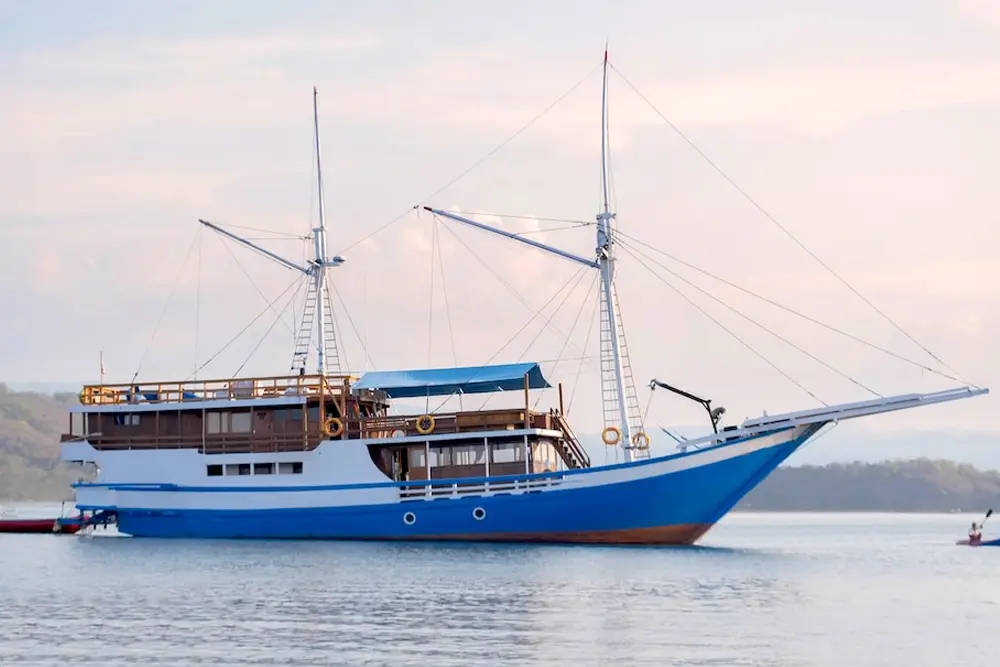
TemuKira Liveaboard, Indonesia
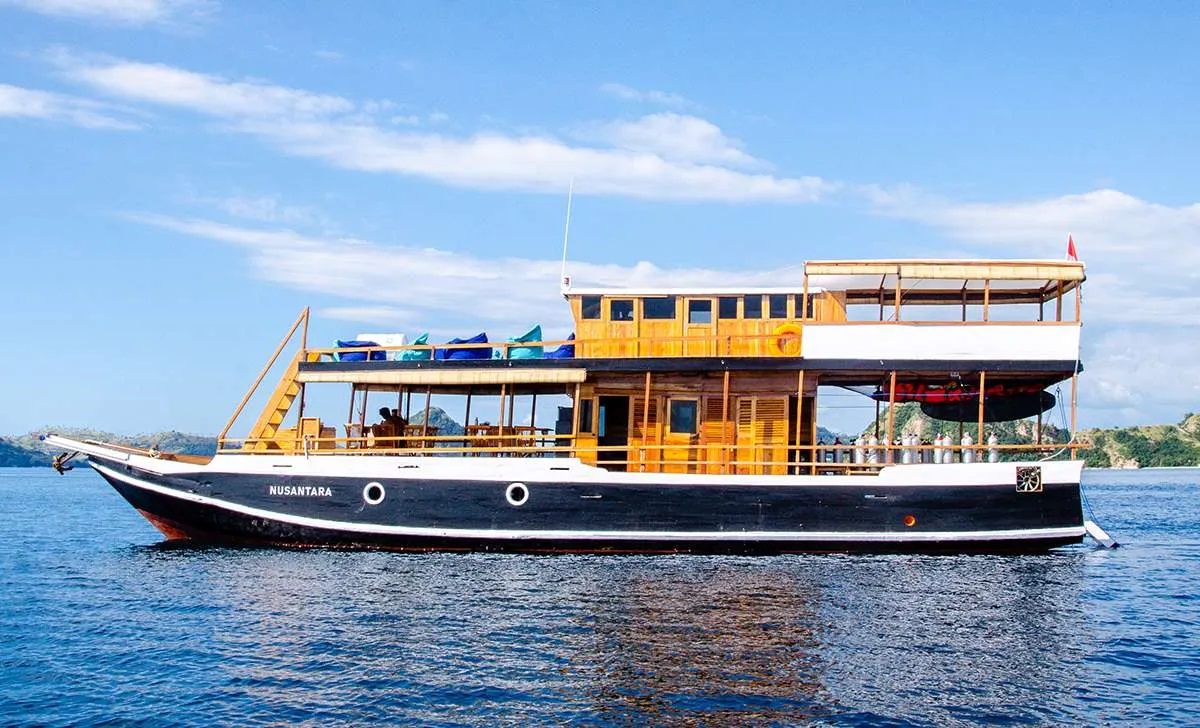
TemuKira is a wooden schooner operating in Indonesia, offering small-group liveaboard diving experiences in Komodo. With six cabins on board, the vessel provides a straightforward setup focused on diving.
Boat Interior
The interior includes an air-conditioned lounge with seating for all guests. The space is designed for shared use and is equipped with a TV and DVD player. A shaded sun deck with an awning provides an additional outdoor area for relaxation.
Dive Deck
Diving operations are supported by 12 gear-up stations and 20 scuba tanks. A Bauer compressor is available onboard. A dedicated dive platform with a shower allows for convenient water access, while a single tender equipped with a 40 HP engine is used for transfers to dive sites.
Safety and Navigation
Onboard safety equipment includes life rafts, life buoys, life jackets, emergency oxygen, and a first aid kit. A satellite phone is available for communication.
Itineraries
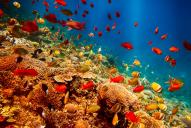
TemuKira operates scheduled diving itineraries within Komodo National Park, with departures and returns from Labuan Bajo. Trips are organised as multi-day routes across different areas of the park, featuring varied underwater terrain such as reef slopes, pinnacles, and coral gardens.
When to Go
Komodo is a year-round diving destination, with seasonal variations across different parts of the park. Water temperatures are generally warmer in the north and cooler in the south, where nutrient-rich currents influence conditions. The period between March and October is typically more favourable, although trips operate throughout the year with routes adjusted based on conditions.
Boat for Photographers
Onboard facilities include camera charging stations and designated work areas.
Cabin Types
Accommodation is arranged across six cabins for up to 12 guests. Each cabin is air-conditioned and includes a private bathroom with a shower, wash basin, and toilet. Towels and basic toiletries are provided for all guests
Cabins
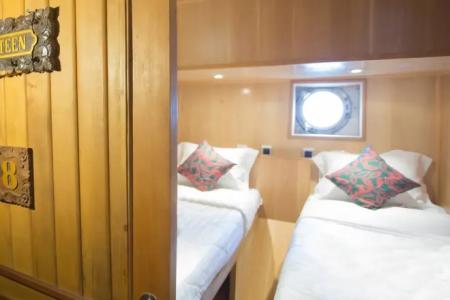
Twin Cabin
Twin Cabin
Twin Cabin
Deck:Lower Deck
Bedding:Twin Beds
Max occupancy:2 Guests
Number of Cabins:2 Cabins
Ensuite Bathroom: Yes
Aircon: Yes
- Basic Toiletries
Twin cabin located on the lower deck, fitted with twin beds. The cabin is air-conditioned and features an ensuite bathroom with a shower, wash basin, and toilet
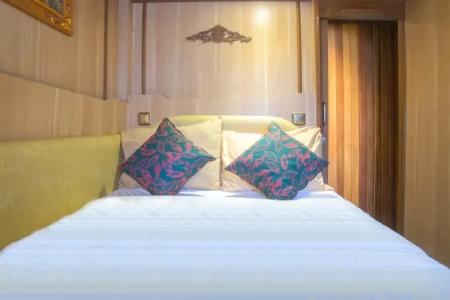
Double Cabin
Double Cabin
Double Cabin
Deck:Lower Deck
Bedding:Double Bed
Max occupancy:2 Guests
Number of Cabins:3 Cabins
Ensuite Bathroom: Yes
Aircon: Yes
- Basic Toiletries
Double cabin located on the lower deck, fitted with a double bed. The cabin is air-conditioned and features an ensuite bathroom with a shower, wash basin, and toilet.
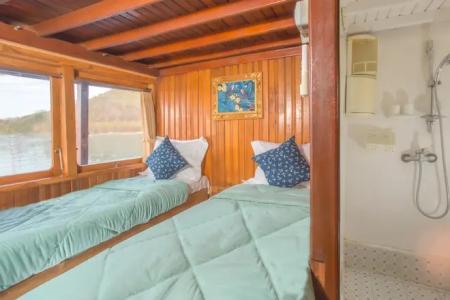
Twin Cabin
Twin Cabin
Twin Cabin
Deck:Upper Deck
Bedding:Twin Beds
Max occupancy:2 Guests
Number of Cabins:1 Cabin
Ensuite Bathroom: Yes
Aircon: Yes
- Basic Toiletries
Twin cabin located on the upper deck, fitted with twin beds. The cabin is air-conditioned and features an ensuite bathroom with a shower, wash basin, and toilet.
Boat Specification
Dive Facilities
- Compressors
- Tenders for Diving
- Dive Deck
Boat navigation & safety
Full safety
Food & Drinks
- Western Food
- Local Food
Onboard Facilities
- Audio & Video Entertainment
- Air Conditioned Saloon
- Sun Deck
Photographer Facilities
- Camera & Photography Station
- Charging Stations
Similar Liveaboards


TemuKira Liveaboard Itineraries
Komodo (7 nights) (Labuan Bajo-Labuan Bajo)
Included
- 8 days/ 7 nights accommodation on board
- Full board meal
- Transfer from/to the airport (round-trip, only on boat arrival & departure days)
- Transfer from/to local hotels (round-trip, only on boat arrival & departure days)
- Weight Belt/Weights/Tank(s)
- Dive guides
- Island tours
- Free short-term DAN diving insurance (upon request)
Obligatory surcharges
- Diving / Travel insurance
- Komodo National Park fee: 125.00EUR per trip, to be paid in advance
Extra cost
- Domestic flights
- Gratuities
- Alcoholic Beverages
- Soft drinks
Program
Arrive in Labuan Bajo, pick up at the airport, then transfer to the harbor to board the boat.
Check dive in Sebayur Kecil
Already in the descent, you can admire the huge amount of hard corals, seafans, and sponges that grow lush at all depths. The reef gently slopes until the white sand bottom at around 19m. Here and there, small rock formations are also covered with marine life. Large cuttlefish, octopus, ghost pipefish, frogfish, leafy scorpionfish, and electric clams are just some of the many inhabitants of this area.
No current, always good visibility, and lots of sea life make this dive site a perfect place for routine check dives as well as afternoon dives.
Day 2: Full day dive (up to 4 dives)
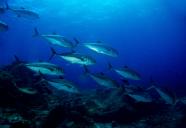
Crystal Rock: named after the surrounding clear water, which just breaks the surface and is home to large schools of fusiliers and anthias beneath it. Nice soft coral coverage here with some impressive table corals. There is a small mound northwest of the rock where different species of fish school seasonally, including tuna and mackerel. Castle Rock is another nearby spot with great fish life, including batfish and morays. Soft corals and sea fans are prolific at around 20 meters.
Currents can be strong, usually flow astwards, and are much stronger at the surface than in the deeper water. Yet it is possible to find shelter around the top of the rock, where the conditions are mostly calmer, for which this site is named. Sharks and big rays can be spotted here.
Shot Gun: a great reef dive site with some fantastic coral coverage that eventually forms walls that are covered with a magnificent array of beautiful yellow corals. The dive site is also known as the Cauldron and is found in a channel between Gili Lawa Darat and Gili Lawa Laut. It is said to be one of the most amazing dive sites in the Komodo area due to the amazing corals and marine life.
You should be able to spot eels, sharks, stingrays, tuna fish, trevallies, anchovies, bump head parrotfish, turtles, snappers, and, of course, the many manta rays.
Gili Lawa Bay: good night dive spots, where you can spot some Harlequin Shrimp as well as a few other interesting creatures.
Day 3: Full day dive (up to 4 dives)
Batu Bolong offers truly world-class diving in the heart of the Komodo Island and National Park Reserve. Although it doesn’t look like much on the surface – in fact, it somewhat resembles an odd doughnut-shaped rock, hence the translation to “Hollow Rock” – a quick glance underwater reveals what all the spectacular dive stories are about.
You should look out for reef sharks lurking by the ledge as well as dogtooth tuna, hawksbill turtles, giant trevallies, and electric blue surgeonfish.
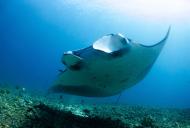
Manta Point: one of the most dived sites in the park. Your best chance to dive with manta rays, which sometimes school in the area.
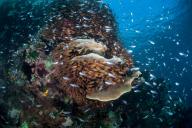
Tatawa Kecil: the dive site has an enormous abundance of reef fish, and if you are looking for anthias, then this is the place to dive. You will find groupers, jacks, sweetlips, trevally, and bump-head parrotfish, as well as turtles and sharks.
As it is not too far from Manta Alley, the dive site situated at the Manta feeding point, the occasional Manta Ray joins divers visiting the site.
Day 4: Komodo Island
Trekking to Komodo Island: after breakfast, trekking to Komodo Island to witness the Komodo dragons and other animals in the wild.
Pink Beach, also called Pantai Merah. The nearby beach is very famous for the red sand that has been created by microscopic animals that produce red and pink light found living on the reef.
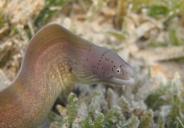
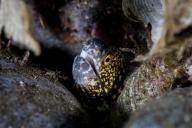
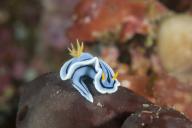
The dive site has a sandy-sloped bottom that is also made up of this pink sand, creating a very unusual and unique dive site. You will find frogfish, leaf fish, mandarin fish, Coleman shrimp, nudibranchs, Pegasus sea moths, snake eels, crocodile fish, ribbon eels, and devilfish.
There are many large soft corals found here, with many yellow sea cucumbers and feather stars to be found as well.
Pulau Damar
Loh Sera: Large pelagic fish like dogtooth tuna can be seen circling off the point and around the pinnacles. Turtles and large fish such as monster- sized giant trevallies, potato cod, malabar grouper, schools of bumphead parrotfish, napoleon wrasse, manta rays, and much more can be sighted along the wall. Superb diving all along the southern point of Loh Sera, or off the point towards underwater pinnacles.
Day 5: Full day dive (up to 4 dives)
Manta Alley (2 dives): this dive site is definitely an unforgettable dive experience, and it is a highlight of the Komodo National Park, and for good reasons. The site is the home to throngs of manta rays that swim, play around, and feed relentlessly whilst being cleaned by cleaner wrasses.
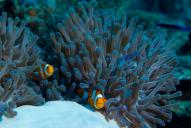
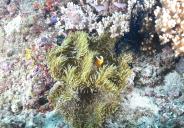
Amongst the reef, there are anemone fish, triggerfish, unicorn fish, and moray eels. The reef is also home to large groups of mantis shrimp that can be found in the nooks and crevices. These have very powerful claws that have earned them the nickname of “thumb splitters” for their ability to inflict pain on an unsuspecting, misplaced hand.
Nusa Kode (2 dives): the south-western tip of Kode island is characterized by large, coral-encrusted boulders and huge groupers. Amongst the boulders are some of the largest reef fishes in the Park, such as the giant potato cod and malabar grouper. Schools of large red snapper are normally prevalent. The diving entry is west of a small island at this site
Day 6: Trekking and 3 dives
Padar Island is the most iconic view of the region. From the summit, you can spot more than ten different beaches. Make the trek up the steep hill for only about 20 minutes.
Day 7: Back to Central Komodo National Park
Tatawa Besar: This site is famous for having some of the most astonishing coral gardens in the Komodo National Park. Given the diversity of coral in the national park, this makes the site one of the best coral gardens in the world. You will be accompanied by cuttlefish, turtles, lionfish, triggerfish, batfish, and it is easy to spot sharks swimming amongst the gardens.
Siaba Besar: a dive destination known for its massive coral garden.
Get ready to explore a diving destination where you get to experience the best of both worlds. Enjoy the sights of the pelagic fish species such as manta rays, reef sharks, turtles, and much more, as well as gorgeous Flamboyant Cuttlefish and Thorny Seahorses.
Back to Labuan Bajo
Day 8: Disembarkation in Labuan Bajo
After breakfast, transfer back to the airport for the onward flight.
Routes can be affected by adverse weather conditions and unforeseen events, force majeure or other similar reasons