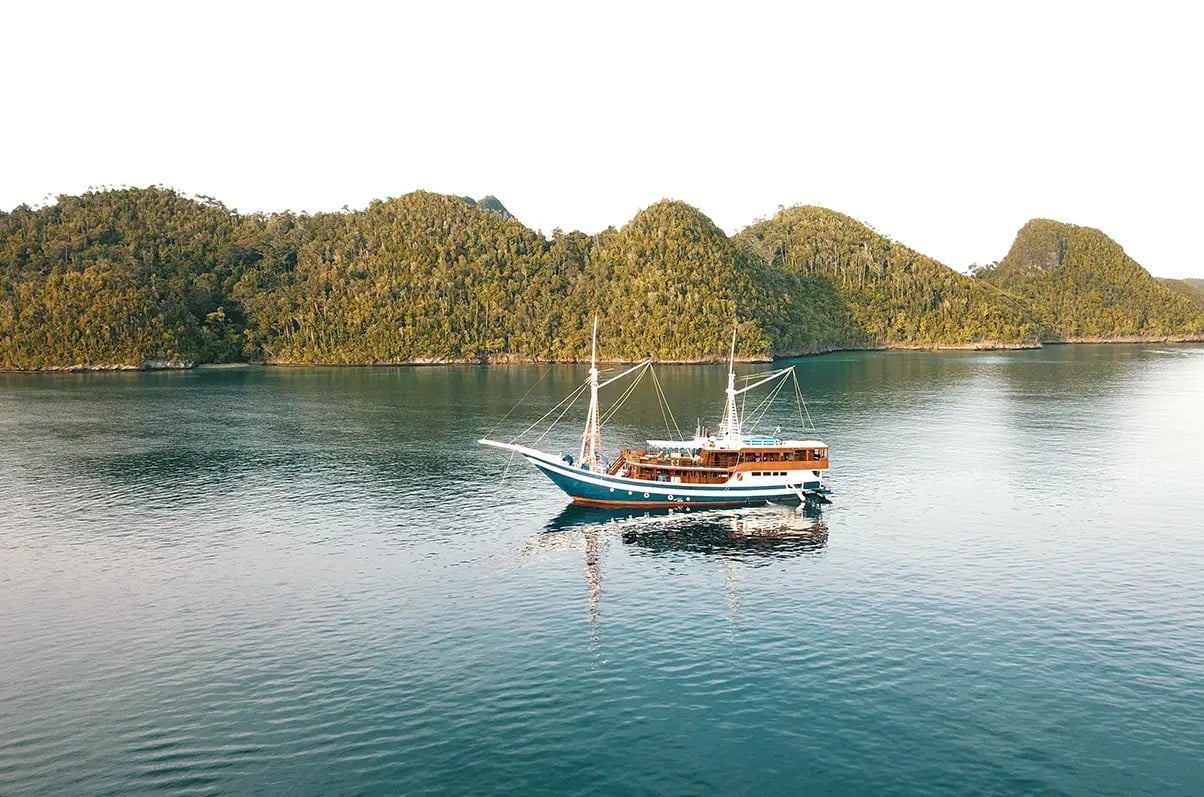
Raja Ampat Explorer Liveaboard, Indonesia
Cabin Types
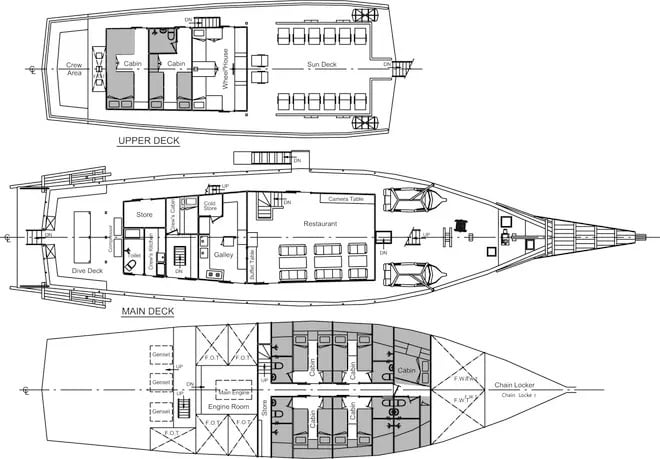
Accommodation is arranged in 7 air-conditioned cabins for up to 14 guests. Cabins are configured as double or twin rooms, each with an ensuite bathroom including a hot shower, washbasin, and toilet. Warm water showers are available, and the overall setup is designed to support shared occupancy in a practical, compact format.Boat Interior
The indoor social space includes an air-conditioned lounge with dining seating for 14 guests. This area also includes a TV and CD/DVD player, creating a central room for meals, downtime, and evening relaxation. The partially covered sun deck offers an additional open-air space to sit back between dives or at the end of the day.Food & Drinks
Meals are served buffet-style and combine Indonesian and European dishes. The onboard dining setup is simple and social, with all guests able to dine together in the lounge area.Dive Deck
The MV Raja Ampat Explorer is arranged with divers in mind. There are 14 individual gear-up stations, 20 scuba tanks, a Coltri Sub compressor, camera work stations, and camera battery charging stations. The dive platform includes a shower, and two tenders provide diver drop-off and pick-up, each with a maximum capacity of 8 divers.Divers can expect up to 3 dives a day, depending on the itinerary and conditions.
Safety
Safety equipment on board includes 2 life rafts, 4 life buoys, 50 life jackets, 1 cylinder of emergency oxygen, and a first aid kit. A satellite telephone is also carried on board. Electricity is 220V.Itineraries
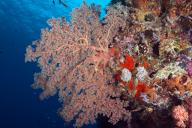
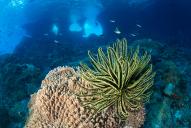
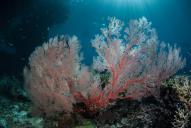
Raja Ampat Explorer operates 7-night and 10-night cruises in Raja Ampat and the Banda Sea.Raja Ampat itineraries depart from and return to Sorong and include locations such as Misool, Fam, Arborek, and Mansuar. These routes focus on the region’s marine diversity and reef systems.
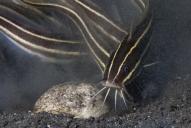
Banda Sea trips depart from and return to Ambon. Highlights include sea snakes at Gunung Api, macro life and critters in Ambon, and hammerhead sharks around Banda. This combination gives the route a broader mix of pelagic encounters and smaller marine subjects
Cabins
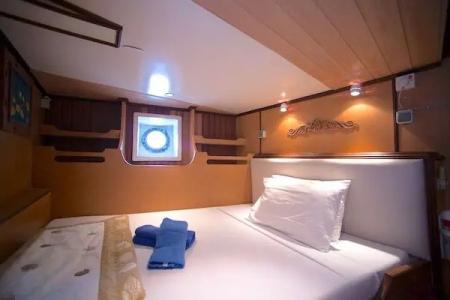
Double Cabin
Double Cabin
Double Cabin
Deck:Lower Deck
Bedding:Double Bed
Max occupancy:2 Guests
Number of Cabins:1 Cabin
Ensuite Bathroom: Yes
Aircon: Yes
- Towels
- Basic Toiletries
1 Double Bed Cabin: located on the lower deck, with a double bed, portholes, A/C and en-suite bathroom
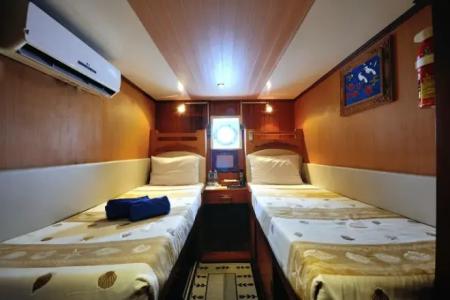
Twin Bed Cabin
Twin Bed Cabin
Twin Bed Cabin
Deck:Lower Deck
Bedding:Twin Beds
Max occupancy:2 Guests
Number of Cabins:4 Cabins
Ensuite Bathroom: Yes
Aircon: Yes
- Towels
- Basic Toiletries
These Air-Conditioned cabins with twin beds have an en-suite bathroom, a hot shower, a wash basin, and a toilet are a great place to relax after a long day diving
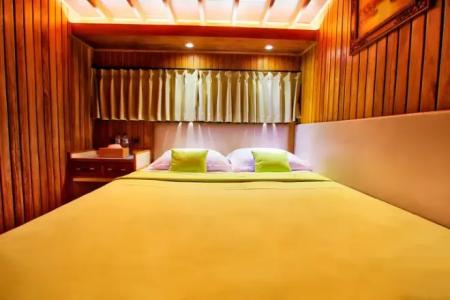
Double Cabin
Double Cabin
Double Cabin
Deck:Upper Deck
Bedding:Double Bed
Max occupancy:2 Guests
Number of Cabins:1 Cabin
Ensuite Bathroom: Yes
Aircon: Yes
- Towels
- Basic Toiletries
1 Double Bed Cabin: located on the Upper Deck, with a double bed, sea view windows, A/C and en-suite bathroom
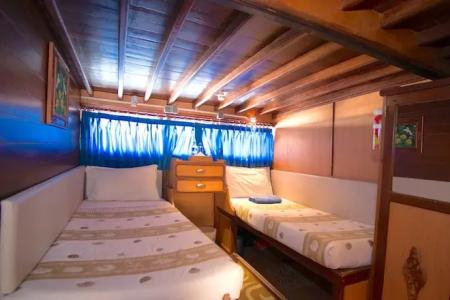
Twin Cabin
Twin Cabin
Twin Cabin
Deck:Upper Deck
Bedding:Twin Beds
Max occupancy:2 Guests
Number of Cabins:1 Cabin
Ensuite Bathroom: Yes
Aircon: Yes
- Towels
- Basic Toiletries
1 Twin Beds Cabin: located on the Upper Deck, with two single beds, sea view windows, A/C and en-suite bathroom
Boat Specification
Dive Facilities
- Warm Water Showers
- Compressors
- Tenders for Diving
- Dive Deck
- DIN Adaptors
Boat navigation & safety
Full safety
Food & Drinks
- Western Food
- Local Food
- Dietary Restrictions
- Buffet Style
Onboard Facilities
- Audio & Video Entertainment
- Sun Deck
- Indoor Saloon
Photographer Facilities
- Camera & Photography Station
- Charging Stations
Similar Liveaboards


Raja Ampat Explorer Liveaboard Itineraries
Raja Ampat - Fam - Central (10 nights) (Port of Sorong-Port of Sorong)
Included
- Accommodation on board
- Full board
- Transfer from/to the airport (round-trip, only on boat arrival & departure days)
- Transfer from/to local hotels (round-trip, only on boat arrival & departure days)
- Weight Belt/Weights/Tank(s)
- Dive guides
- Island tours
- Free short-term DAN diving insurance (upon request)
Obligatory surcharges
- Diving / Travel insurance
- Raja Ampat conservation fee: 85.00EUR per trip, to be paid in advance
- Raja Ampat harbor fee & retribution fee: 45.00EUR per trip, to be paid in advance
Extra cost
- Domestic flights
- Gratuities
- Alcoholic Beverages
- Soft drinks
Program
Pick up at the airport and transfer to the harbor to board the boat.
Sailing to Waisai for clearance.
Day 2: Dampier Strait – up to 4 dives.
1st dive at Mioskon: as soon as leaving Waisai, we do a check dive at the nearby island of Mioskon. It offers a relatively easy dive condition with a healthy reef and a variety of fish. Schools of Yellow Snapper, Napoleon Wrasse, big groupers, and Wobbegong sharks can be found here. Pigmy seahorses and different species of nudibranch can be seen as well.
2nd dive Lao Lao: Lao Lao is a pretty deep dive, so don’t expect to be down for too long.
The slope down is covered in clusters of pinnacles and coral bommies, which you may find as respite from the current. It’s an impressive dive site on all levels, with interesting coral formations and a ton of schooling fish
3rd dive at Blue Magic: at this dive site, divers regularly see a large number of pelagic species, including reef sharks, manta rays, jacks, barracudas, and tuna. It also frequently offers a chance to see the oceanic manta.
Night dive at Sapokren: the village of Sapokren is located on the island of Waigeo, close to the capital town of Waisai. This site is typically dived at night; however, day diving is good too. Saporkren is your typical sandy bottom muck dive site, which is a little grubby since it's just off the village jetty.
Day 3: Dampier Strait – up to 4 dives
1st dive at Friwen Wall: This location is known for its wall diving, decorated with colorful coral reefs, beautiful fish, and a variety of macro marine life, making it one of the world's underwater paradises.
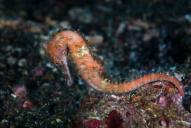
2nd dive at Sardine’s Reef: don’t get wrong, there are no sardines on this site! The name comes from the density of fish that can be found here, which is sometimes comparable to a school of sardines: tuna, barracuda, jacks, wrasses, parrotfish, and many sharks (gray, white tip, and black carpet). The sea fans here are great spots to see three species of pygmy seahorses (Denise, Bargibanti, and Pontohi).
3rd dive at Chicken Reef: dotted with large coral bommies (which you could easily spend the majority of your dive exploring) as plenty of critters can be found hiding within the gorgonian fans, anemones, and soft coral formations.
Night dive at RADL Jetty: the drifting current of Mansuar's northern coast has contributed much to the rich life emerged along the house reef at RADL (Raja Ampat Dive Lodge) where varieties of critters can be spotted during night dive.
Day 4: Tanjung Putus – up to 4 dives
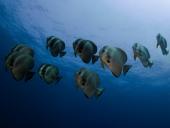
1st dive at Mayhem Reef: This site has a great variety of encounters, from large schools of fusiliers, snappers, jacks, and batfish to wobbegongs and pygmy seahorses on the bottom. The ideal dive on Mayhem involves dropping in along the edge of the pinnacle along the current side and watching the schools of fish parading in the current. As bottom time slips away, it’s time to swim along the plentiful large bommies leading toward the shallows.
2nd dive at Citrus Ridge: The reef is made up of a ridge that slopes down, and it is one of the dive sites that are often called aquariums for the vast numbers of marine life that exist here. There are many bommies littered on the sandy bottom. The soft corals are home to literally thousands of glassfish that nest all over the dive site. The sea fans are home to many different types of sea horses, including pygmy seahorses. There are also many different types of sweetlips and jaw fish.
3rd dive at Gam Channel
Night dive at BJ’s Reef
Day 5: FAM – 3 dives.
1st dive at Melisa’s Garden: you will start to encounter the amazing diversity of coral and fish life that this reef has to offer. As you get closer to the top of the reef, you will find that the corals fight with each other for space, making it one of the most spectacular garden reefs.
2nd dive at My Reef: This reef is more of a large pinnacle extending 30 meters beyond the island, and has some super strong water currents sometimes. The schools of big barracudas and snappers will greet you, and you will be at a loss for where to look and where not to.
3rd dive at Fam Wall
Pianemo
Day 6: Tanjung Putus - 4 dives
1st dive at Mayhem Reef: This site has a great variety of encounters, from large schools of fusiliers, snappers, jacks, and batfish to wobbegongs and pygmy seahorses on the bottom. The ideal dive on Mayhem involves dropping in along the edge of the pinnacle along the current side and watching the schools of fish parading in the current. As bottom time slips away, it’s time to swim along the plentiful large bommies leading toward the shallows.
2nd dive at Mambrayup Reef
3rd dive at Citrus Ridge: The reef is made up of a ridge that slopes down, and it is one of the dive sites that are often called aquariums for the vast numbers of marine life that exist here. There are many bommies littered on the sandy bottom. The soft corals are home to literally thousands of glassfish that nest all over the dive site. The sea fans are home to many different types of sea horses, including pygmy seahorses. There are also many different types of sweetlips and jaw fish.
Night dive at Yanggefo Ridge
Day 7: Arborek – up to 4 dives.
1st dive at Manta Sandy: one of the most dived sites in northern Raja Ampat to see manta rays. It’s a sandy bottom playground at 20m where manta rays, both black and white, love to flock and play during cleaning season. Butterfly fish and numerous cleaner wrasses can thus be seen at this site too.
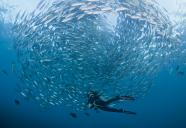
2nd dive at Arborek Jetty: you can encounter huge schools of fish that take shelter beneath the jetty of Arborek village. The large schools of fish spin like a tornado, especially between 3 PM and 6 PM, when there is a fish feeding frenzy! Look out for giant clams sheltering beneath Arborek Jetty, and soft corals that camouflage their piles in colorful swathes.
3rd dive at Sawandarek Jetty: for the turtle lovers, you will encounter larger than usual green turtles, Giant clams, and large schools of fusiliers and barracuda. It also has a wide variety of macro life.
Night dive at Ransiwor
Day 8: Mansuar – up to 4 dives.
1st dive at Yenbuba Jetty: is home to many wonderful fish, in all shapes and sizes. The jetty offers pretty fans and soft corals, plus the village kids who love to dive-bomb in from the top.
2nd dive at Cape Kri: holds the world record for the site with the largest number of species referenced in one single dive! The crossroads of different currents at the tip of the island of Kri have created an incredible variety of marine biodiversity – all kinds of sharks, many schools of fish, amazing coral diversity, and specimens for macro fans.
3rd dive at Pulau Roti
Night dive at Friwen Wall
Day 9: Dampier Strait
1st dive at Sardine’s Reef: don’t get wrong, there are no sardines on this site! The name comes from the density of fish that can be found here, which is sometimes comparable to a school of sardines: tuna, barracuda, jacks, wrasses, parrotfish, and many sharks (gray, white tip, and black carpet). The sea fans here are great spots to see three species of pygmy seahorses (Denise, Bargibanti, and Pontohi).
2nd dive at Chicken Reef: dotted with large coral bommies (which you could easily spend the majority of your dive exploring) as plenty of critters can be found hiding within the gorgonian fans, anemones, and soft coral formations.
3rd dive at Lao – Lao
Night dive at Mioskon
Day 10: Mansuar
1st dive at Cape Kri: holds the world record for the site with the largest number of species referenced in one single dive! The crossroads of different currents at the tip of the island of Kri have created an incredible variety of marine biodiversity – all kinds of sharks, many schools of fish, amazing coral diversity, and specimens for macro fans.
2nd dive at Yenbuba Jetty: is home to many wonderful fish, in all shapes and sizes. The jetty offers pretty fans and soft corals, plus the village kids who love to dive-bomb in from the top.
Sail back to Sorong.
Day 11: Disembarkation in Sorong.
After breakfast, transfer to the airport for onward flight.
Routes can be affected by adverse weather conditions and unforeseen events, force majeure or other similar reasons
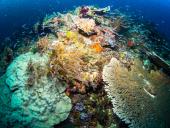
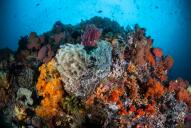
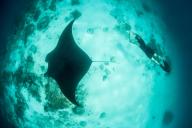
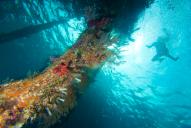
Misool - Fam - Central (10 nights) (Port of Sorong-Port of Sorong)
Included
- 11 days/ 10 nights accommodation on board
- Full board meal
- Transfer from/to the airport (round-trip, only on boat arrival & departure days)
- Transfer from/to local hotels (round-trip, only on boat arrival & departure days)
- Weight Belt/Weights/Tank(s)
- Dive guides
- Island tours
- Free short-term DAN diving insurance (upon request)
Obligatory surcharges
- Diving / Travel insurance
- Raja Ampat conservation fee: 85.00EUR per trip, to be paid in advance
- Raja Ampat harbor fee & retribution fee: 45.00EUR per trip, to be paid in advance
Extra cost
- Domestic flights
- Gratuities
- Alcoholic Beverages
- Soft drinks
Program
Pick up at airport and transfer to harbor to board the boat.
Sailing to Misool
Day 2: Misool – up to 4 dives
1st dive at Yeliet Kecil
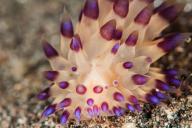
2nd dive at Nudi Rock: a great spot for divers who want to spot pelagic fish, and it is also a great spot for macro underwater photography. The dive site is named because it is a place to find Nudibranchs, and also because the small island resembles a nudibranch. The island even has trees on it that look like the rhinophores and gills of a nudibranch. The wind gently sways the trees, making them resemble a nudibranch in the currents below.
3rd dive at Tank Rock : 3 pinnacles lie to the east of Tank Rock. Giant grouper, 6 – 8 feet long, may approach close to divers in deeper waters. The fish schools around these pinnacles can make it difficult to see the reef. One of the most pristine coral reefs.
Night dive at Romeo: a great night dive for the endemic epaulette shark, the 'walking' shark.
Day 3: Misool – up to 4 dives
1st dive Magic Mountain: also known as Shadow Reef for its amazing corals, this is one of the prime sites in Misool. An underwater seamount with lots of currents around it, it is a popular Manta Ray and Shark cleaning area.
2nd dive at Boo Window: features an interesting underwater topography with a number of large swim-throughs, or so-called windows that start to appear just below the sea surface.
3rd dive at Boo West.
Night dive at Yeliet Besar
Day 4: Misool – 3 dives + hiking
1st dive at Four Kings: this site features schooling barracudas, smaller schools of jacks, scorpionfish, napoleon wrasse, and huge potato groupers. The pinnacles themselves are dramatic structures, with vibrant colors and corals and good visibility as well.
2nd dive at Wedding Cake
3rd dive at Gorgonian Passage: a stunning wall with impressive corals dominated by enormous sea fans, which really make this a breathtaking site.
Hiking to Love Lagoon to overlook the beautiful heart-shaped lagoon
Day 5: Misool – 1 dive, then crossing to Fam island
Dive at Puri Pinnacle: the huge sardine ball frenzy, Predator fishes, including a school of Mobula rays, were feasting on millions of sardines and other fish.
Sailing to Fam
Day 6: Fam island - up to 4 dives
1st dive at My Reef: this reef is more of a large pinnacle extending 30 meters beyond the island, and has some super strong water currents sometimes. The schools of big barracudas and snappers will greet you, and you will be at a loss for where to look and where not to.
2nd dive at Melisa’s Garden: you will start to encounter the amazing diversity of coral and fish life that this reef has to offer. As you get closer to the top of the reef, you will find that the corals fight with each other for space, making it one of the most spectacular garden reefs.
3rd dive at Keruo Channel: Coral reefs are diverse underwater ecosystems held together by calcium carbonate structures secreted by corals. Coral reefs are built by colonies of tiny animals found in marine waters that contain few nutrients.
Night dive at Fam Jetty
Day 7: Fam island - 3 dives + hiking
Hiking to the top of the hill to overlook the stunning view of Piaynemo lagoon
1st dive at Melisa’s Garden: you will start to encounter the amazing diversity of coral and fish life that this reef has to offer. As you get closer to the top of the reef you will find that the corals fight with each other for space, making it one of the most spectacular garden reefs.
2nd dive at My Reef: This reef is more of a large pinnacle extending 30 meters beyond the island, and has some super strong water currents sometimes. The schools of big barracudas and snappers will greet you, and you will be at a loss for where to look and where not to.
Night dive at Galaxy
Day 8: Mansuar – up to 4 dives
1st dive at West Mansuar
2nd dive at Manta Sandy: one of the most dived sites in northern Raja Ampat to see manta rays. It’s a sandy bottom playground at 20m where manta rays, both black and white, love to flock and play during cleaning season. Butterfly fish and numerous cleaner wrasses can thus be seen at this site too.
3rd dive at Arborek Jetty: you can encounter huge schools of fish that take shelter beneath the jetty of Arborek village. The large schools of fish spin like a tornado, especially between 3 PM and 6 PM, when there is a fish feeding frenzy! Look out for giant clams sheltering beneath Arborek Jetty, and soft corals that camouflage their piles in colorful swathes.
Night dive at Arborek
Day 9: Tanjung Putus – up to 4 dives
1st dive at Mayhem Reef: This site has a great variety of encounters, from large schools of fusiliers, snappers, jacks, and batfish to wobbegongs and pygmy seahorses on the bottom. The ideal dive on Mayhem involves dropping in along the edge of the pinnacle along the current side and watching the schools of fish parading in the current. As bottom time slips away, it’s time to swim along the plentiful large bommies leading toward the shallows.
2nd dive at Citrus Ridge: The reef is made up of a ridge that slopes down, and it is one of the dive sites that are often called aquariums for the vast numbers of marine life that exist here. There are many bommies littered on the sandy bottom. The soft corals are home to literally thousands of glassfish that nest all over the dive site. The sea fans are home to many different types of sea horses, including pygmy seahorses. There are also many different types of sweetlips and jaw fish.
3rd dive at Gam Channel
Night dive at Yanggefo Reef
Day 10: Dampier Strait – 2 dives
1st dive at Cape Kri: holds the world record for the site with the largest number of species referenced in one single dive! The crossroads of different currents at the tip of the island of Kri have created an incredible variety of marine biodiversity – all kinds of sharks, many schools of fish, amazing coral diversity, specimens for macro fans.
2nd dive at Yenbuba Jetty: is home to many wonderful fish, in all shapes and sizes. The jetty offers pretty fans and soft corals, plus the village kids who love to dive-bomb in from the top.
Sail back to Sorong.
Day 11: Disembarkation in Sorong.
After breakfast, transfer to the airport for onward flight.
Routes can be affected by adverse weather conditions and unforeseen events, force majeure or other similar reasons