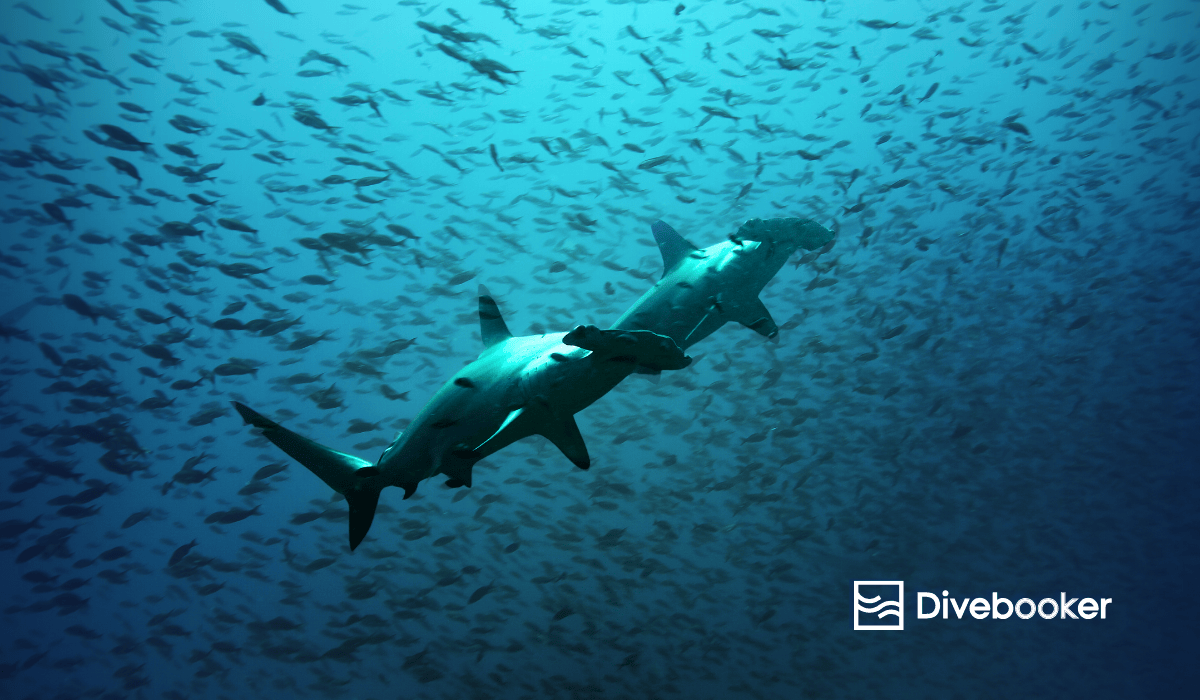
Beneath the surface of the Galápagos Marine Reserve, the ocean creates a scene of breathtaking scale. A school of hundreds of scalloped hammerhead sharks glides in formation, their unique silhouettes blurring together into a living, moving wall.
For divers seeking the planet’s most iconic shark encounter, this is the moment that defines the journey. The scalloped hammerhead shark Galápagos ecosystem supports is not just a resident; it is a keystone species that exemplifies the wild, current-charged heart of these islands.
While other global destinations offer sightings, the Galápagos Islands provide a profound immersion, setting the gold standard for abundance and awe.
This guide explores exactly why this archipelago is the apex destination for diving with hammerhead sharks in the Galápagos, where to find them, and how to witness this phenomenon for yourself.
Why Galápagos Islands Hammerhead Sharks Define the Region
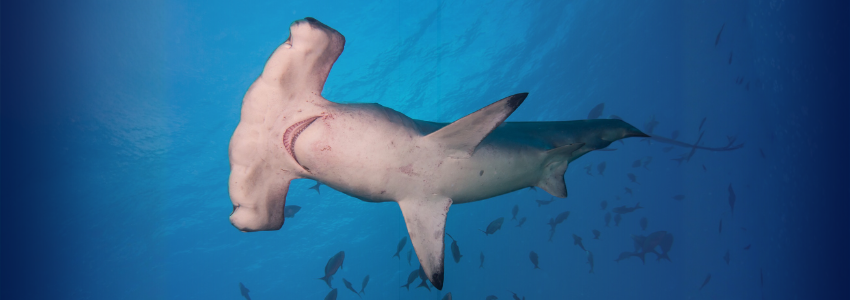
Galápagos Islands hammerhead sharks are a signature species for this remote archipelago. Their large schools point to the health of the marine ecosystem and a major draw for divers. The most common species here, by far, is the scalloped hammerhead (Sphyrna lewini), classified as Critically Endangered globally.
For the complete picture of diving in the archipelago, from marine iguanas to whale sharks, explore our definitive Galapagos Islands diving guide.
Galápagos Hammerhead Shark Facts
| Feature | Detail |
|---|---|
| Scientific Name | Sphyrna lewini |
| Conservation Status | Critically Endangered (IUCN Red List) |
| Notable Behavior | Forms large daytime schools, often at cleaning stations. |
| Global Population Trend | Major decline due to fishing. |
Why They School in the Galápagos
There are two key reasons for explaining the large schools of Galápagos Islands hammerhead sharks. First, the rocky reefs provide sheltered cleaning stations where small fish remove parasites from the sharks. Second, the islands are a navigational hub. Sharks use, among other things, the magnetic fields of underwater mountains to navigate, making the Galápagos a regular gathering point in the vast Pacific.
Visual Impact of the Hammerhead Sharks` School
For divers, a school of hammerhead sharks is defined by scale and number. While individuals average 1.5 – 2 metres in length, females can be as big as 3 meters. Seeing dozens or even hundreds moving together in blue water is a powerful visual experience that highlights the importance of this protected marine reserve.
Top Dive Sites for Galápagos Hammerhead Sharks
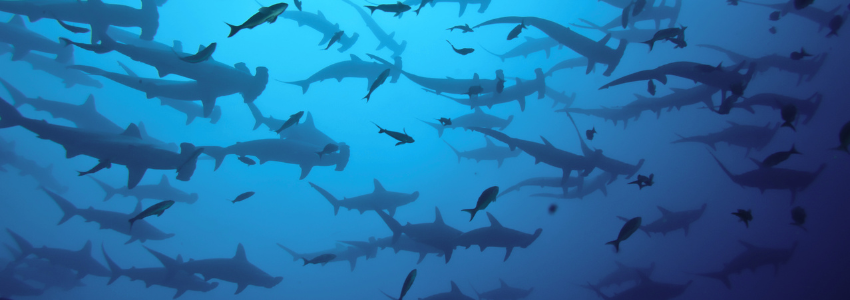
For divers aiming to encounter the famous Galápagos Islands hammerhead sharks, site selection is critical. The archipelago offers a hierarchy of experiences, from legendary remote pinnacles teeming with life to more easily accessible sites near inhabited islands. Divers often wonder where to dive with hammerheads in the Galápagos, so we made a list that details the premier locations, categorized by their location and access requirements.
Top Dive Sites for Hammerhead Sharks
Other Notable Sites for Possible Encounters
While the sites above are the most reliable, where to see hammerheads in Galápagos, sharks can occasionally be found at other locations around the archipelago, often as solitary individuals or small groups.
To choose the right site for your hammerhead shark diving Galápagos trip, your decision hinges on balancing your skill level, budget, and expectations. The remote northern islands deliver an unmatched, high-intensity spectacle for expert divers, while the land-based sites offer a demanding but more accessible taste of this iconic pelagic adventure.
The Best Time to See a Galápagos Hammerhead Shark
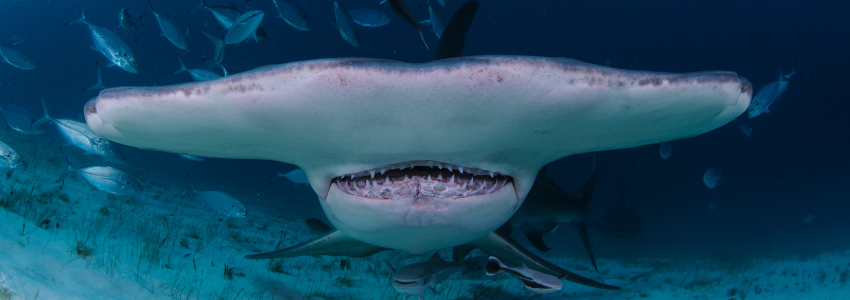
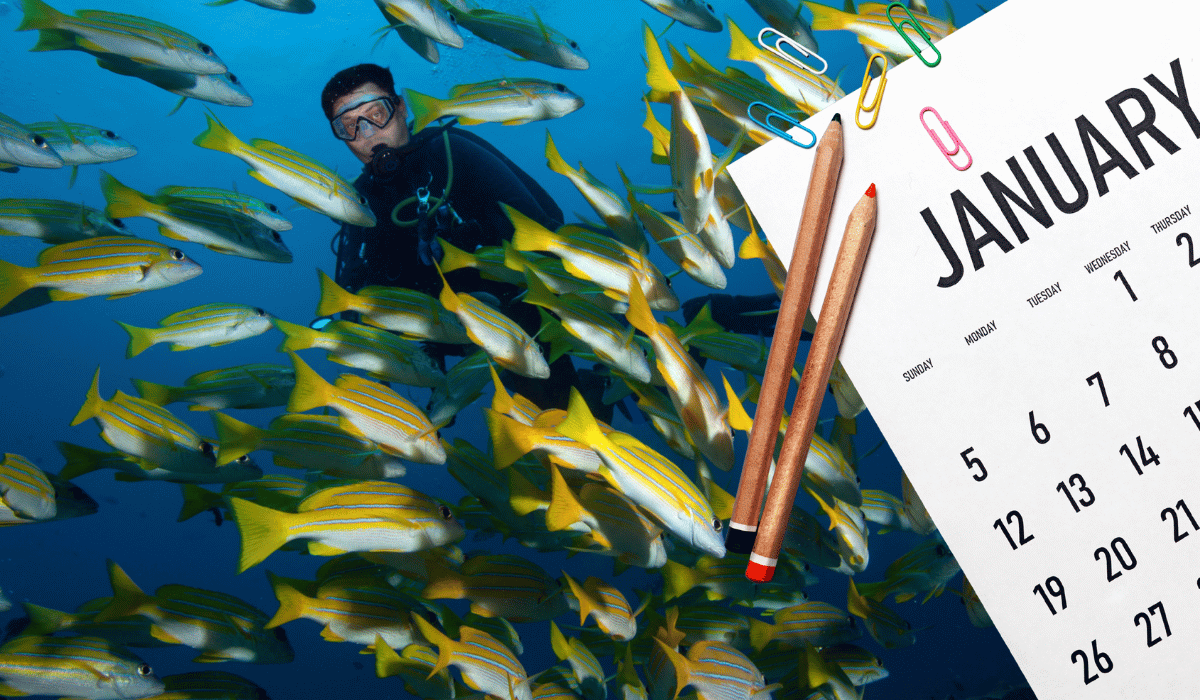
You find the Galápagos hammerhead shark throughout the year, but the size of schools and diving conditions change with the seasons. Your best time to see hammerheads in Galápagos depends on your primary goal: witnessing the largest possible aggregations or enjoying warmer, calmer dives.
The Cool Season (June to November): For the Ultimate Spectacle
For divers seeking the definitive experience of massive schools, the cool season is widely regarded as the best time. During these months, the nutrient-rich Humboldt Current flows strongly, lowering water temperatures and creating an explosion of marine life. This abundance attracts and holds scalloped hammerheads within the Galápagos Marine Reserve, particularly around Darwin and Wolf Islands.
Scientific tracking studies indicate that during this period, up to 90% of monitored hammerhead sharks remain within the reserve, leading to extraordinarily reliable sightings. Dives at the northern islands during this season are famous for schools that can number in the hundreds. A key bonus of this season is the simultaneous presence of whale sharks.
Be prepared for more challenging conditions: stronger currents, cooler water requiring a thicker wetsuit, and sometimes reduced visibility due to plankton.
The Warm Season (December to May): For Warmer, Calmer Dives
If you prefer warmer water and calmer conditions, the warm season offers a different experience. Sea temperatures are more comfortable, visibility is often excellent, and the seas are generally gentler.
Hammerhead sharks do not disappear. A resident population remains, and a larger migratory group is also known to pass through the warmer waters. However, scientific data shows that during this period, hammerheads spend significantly less time concentrated in the reserve, with only about 30% of tracked individuals remaining in protected waters. The animals also tend to be a little deeper, where the water is cooler. You are more likely to see smaller groups or individuals rather than the dense walls characteristic of the cool season.
Addressing the Confusion: When is the True Peak?
A review of diving information reveals conflicting advice, with some sources stating the warm season (January to May) is best for big schools. This contradiction often causes confusion for planners.
The most up-to-date, science-backed consensus, supported by local research and extensive diver reports, points to the cool season (June-November) as the most reliable time for the largest aggregations. Firsthand accounts from experienced divers frequently note that trips in the cool season, such as August, result in non-stop shark action, while warm-season trips, like March, can be unpredictable.
Ultimately, you can see a Galápagos hammerhead shark in any month. Your choice comes down to prioritizing the odds of the most spectacular schooling behavior (cool season) versus more forgiving dive conditions (warm season). For a more detailed breakdown of Galápagos seasonal conditions, see our complete guide on the best time to scuba dive in the Galápagos Islands.
Beyond the Archipelago: Where Else to Find Scalloped Hammerheads
Of course, the Galápagos is not the only destination where you can witness schooling scalloped hammerheads. That said, understanding its place in the Pacific Ocean network of legendary sites helps clarify why this specific archipelago remains the definitive choice for many divers.
The Legendary “Hammerhead Triangle”
The Galápagos forms one point of a famed pelagic corridor known as the “Hammerhead Triangle.” This triangle connects three remote, current-swept islands in the Eastern Tropical Pacific, each a magnet for massive aggregations of the scalloped hammerhead (Sphyrna lewini).
- Cocos Island, Costa Rica: Often called the “Island of the Sharks,” Cocos is a submerged volcano offering thrilling drift dives. It is renowned for equally large schools of scalloped hammerheads, especially at sites like Alcyone. The experience is similar to the northern Galápagos islands, featuring strong currents and cleaning stations. The key differentiator is other species that can be seen aside from the hammerheads; Cocos is famous for additional large pelagics like mantas and immense tuna schools.
- Malpelo Island, Colombia: This solitary rock 500 km from the mainland is a fortress of sheer walls and extreme conditions. It is considered one of the most challenging dive destinations due to its depth, currents, and remoteness. Malpelo is legendary for its “shark tornado”, a dense, swirling vortex of hundreds of scalloped and silky sharks. The encounter is raw and intense, suited only for highly experienced technical divers.
While all three Triangle destinations offer world-class hammerhead action, the Galápagos provides the most comprehensive and accessible expedition. It combines the guaranteed shark density of Cocos and Malpelo with a vastly richer tapestry of endemic wildlife both above and below water, from marine iguanas to penguins.
Other Global Hotspots for Schooling Hammerheads
Beyond the Pacific Triangle, a few other locations offer remarkable, though distinctly different, scalloped hammerhead encounters.
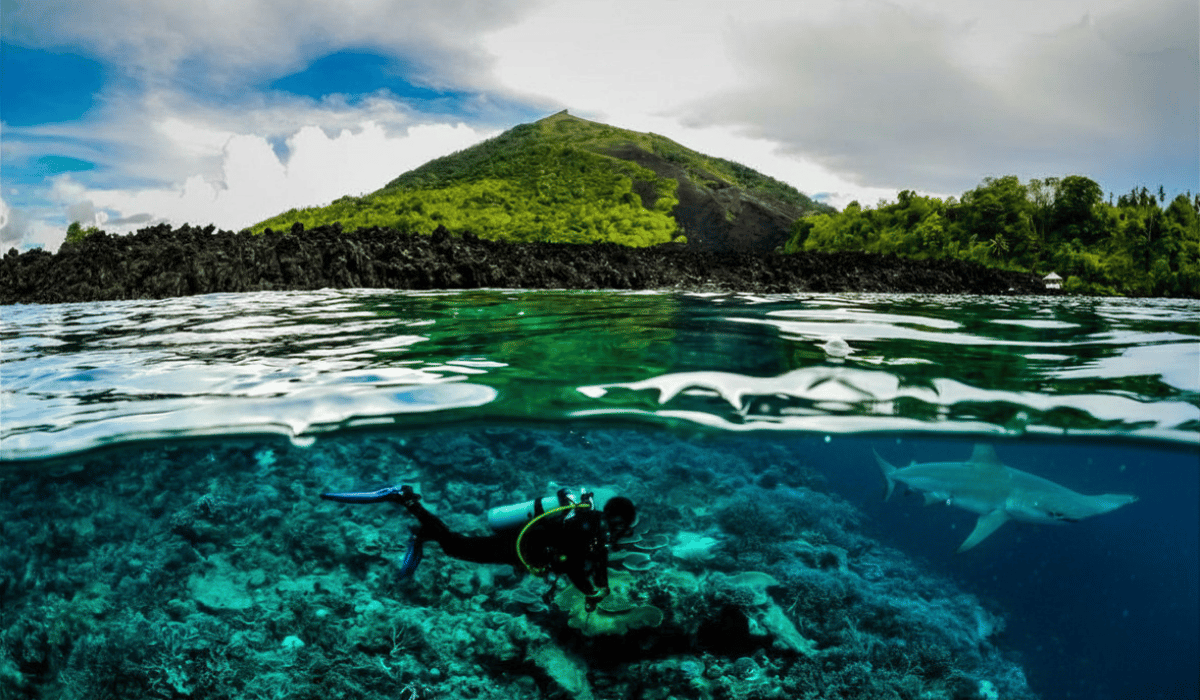
- The Banda Sea, Indonesia: Encounters here are less predictable. Sightings at sites like Banda Neira‘s underwater volcanoes rely on seasonal cold upwellings to bring migrating sharks into recreational diving depths. When conditions align, divers may see small groups of scalloped hammerheads in the deep blue, but it is considered a bonus rather than a guaranteed feature of diving in the biodiverse Coral Triangle.
- The Red Sea, Egypt: For scalloped hammerheads in this region, Daedalus Reef is the primary site. Far offshore, its isolated pinnacle attracts schools, particularly in summer. While the groups are not as vast as in the Pacific Triangle, sightings can be reliable. It is a staple on advanced Red Sea liveaboard itineraries, often combined with Brothers and Elphinstone for the classic Brothers – Daedalus – Elphinstone pelagic circuit.
- Fakarava Atoll, French Polynesia: The powerful incoming current at the South Pass (Tumakohua) channels plankton and fish, attracting large schools of grey reef sharks and, seasonally, scalloped hammerheads. It offers a different context, blending shark action with the atoll’s exceptional biodiversity in a UNESCO biosphere reserve.
- Revillagigedo Archipelago, Mexico: The most famous island in the archipelago is Socorro, and this remote Mexican destination is a haven for giant manta rays and also hosts hammerhead schools. The conditions and hammerhead action are similar to the Galápagos, though they are not always the primary focus for divers there.
Comparing these destinations highlights the specific appeal of the hammerhead shark Galápagos diving experience.
The Galápagos combines exceptional abundance, with some of the largest schools recorded, high predictability of sightings, and a diverse ecological context.
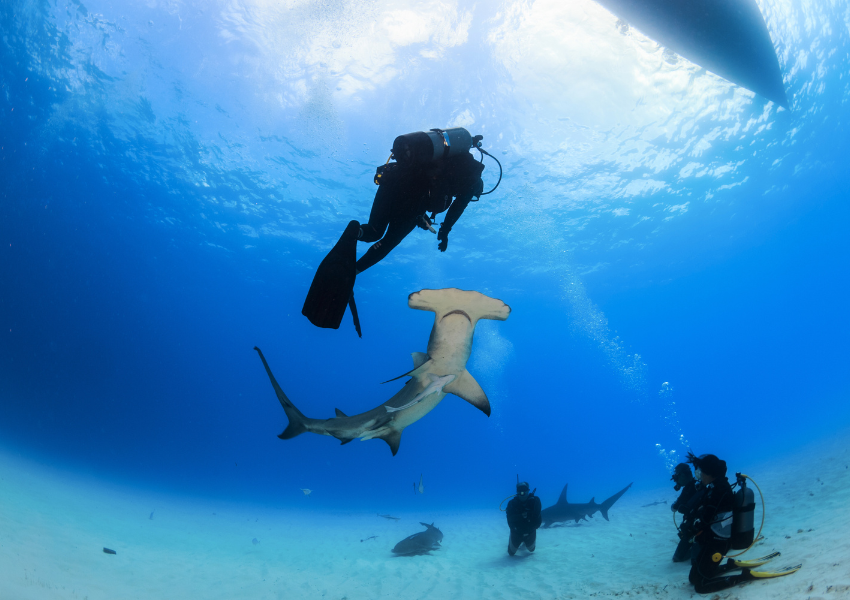
Other locations, like the Bahamas, are famous for close encounters with the solitary great hammerhead (Sphyrna mokarran), a different species with different behavior patterns. For divers considering getting up close with sharks, check out the ultimate shark encounters across the globe or read our feature on diving with sharks in the Bahamas.
Conclusion
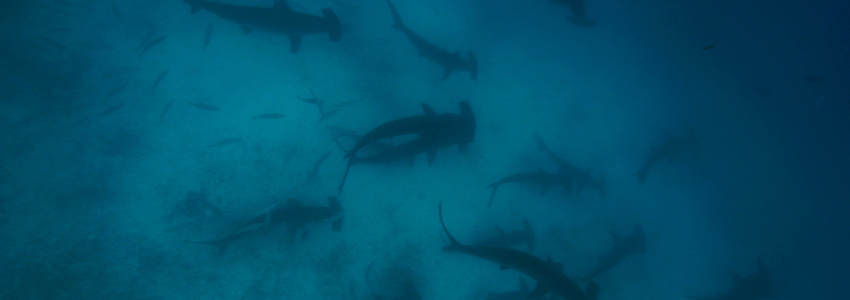
A journey to dive with the hammerhead shark in the Galápagos is more than a trip; it is an immersion into one of the ocean’s last great wilderness spectacles, and the Galápagos delivers a consistent, high-energy spectacle of scalloped hammerhead abundance that defines it as the gold standard. From the sheer awe of a school blotting out the sun at Darwin Island to the reliable encounters at accessible sites like Gordon Rocks, this archipelago delivers the definitive hammerhead experience. The Galápagos Islands hammerhead sharks represent a thriving population in a protected haven, offering a glimpse into a marine world that operates on a breathtaking scale.
And for the question: “Where is the best place to dive with hammerhead sharks?”
While other global destinations deliver encounters, the combination of abundance, guaranteed action, and raw, current-swept drama solidifies the Galápagos as the benchmark for excellence. This privilege comes with a responsibility. Witnessing these critically endangered sharks in such numbers highlights the profound and urgent need to support marine conservation. You leave not only with unforgettable memories but with a renewed understanding of why we protect these wild places.
-
 from$669 /day
from$936 /day
from$832 /day
from$669 /day
from$936 /day
from$832 /day
FAQ: Planning Your Galápagos Hammerhead Dive
What marine life will I see besides Galápagos Islands hammerhead sharks?Divebooker Team2026-02-04T12:33:43+00:00The biodiversity is staggering. You are virtually guaranteed to see Galápagos sharks, playful sea lions, and massive marble rays. Seasonally, you may encounter whale sharks, manta rays, and large pods of dolphins. The reefs are also filled with colourful tropical fish, eels, and turtles.
Can non-diving partners join a liveaboard trip to see hammerhead sharks?Divebooker Team2026-02-04T12:33:14+00:00Some liveaboards may allow this, but opportunities for non-divers are extremely limited. Currents and surface conditions, certainly at Darwin and Wolf, will generally mean no snorkeling. Also, the primary activity is diving, and the boats are far from land. A better alternative is for the non-diver to stay on a central island like Santa Cruz, where snorkelling day trips to places like Kicker Rock offer a chance to see marine life.
How does the experience of diving with hammerhead sharks Galápagos differ from a shark cage dive?Divebooker Team2026-02-04T12:32:43+00:00This is an open-water, unconstrained encounter. You are in the water with the sharks as a passive observer, sharing their environment. Cage dives typically involve baiting sharks to a stationary cage. The Galápagos experience is non-baited, focusing on natural animal behaviour in a wild setting.
I’m prone to seasickness. Is a Galápagos hammerhead shark dive feasible for me?Divebooker Team2026-02-04T12:32:14+00:00The crossings to the northern islands, particularly across the open ocean to Darwin and Wolf, can be rough. If you are very susceptible, choose an itinerary that focuses on the central islands. If you opt for a liveaboard, consult your doctor for medication, choose a cabin in the middle of the ship, and be prepared with remedies like ginger tea.
What is the number one safety rule when diving with hammerhead sharks?Divebooker Team2026-02-04T12:20:52+00:00The cardinal rule is to maintain good buoyancy and keep calm. Do not chase or attempt to touch the sharks. Hammerheads are naturally wary and erratic movements can spook them. Your dive guide will instruct you to hold position on a rocky ledge or in a sandy patch to let the school approach you.
Are liveaboard trips the only way to dive the best hammerhead shark Galápagos sites?Divebooker Team2026-02-04T12:20:14+00:00For the premier sites at Darwin and Wolf Islands, yes. These remote northern islands are only accessible via liveaboard vessels, which typically run 7- to 10-day itineraries. For sites like Gordon Rocks or Kicker Rock, you can base yourself on Santa Cruz or San Cristóbal and take day boats.
What scuba certification level do I need for diving with hammerhead sharks in the Galápagos?Divebooker Team2026-02-04T12:19:38+00:00You must be a certified Advanced Open Water diver with a minimum of 50 logged dives. Most reputable liveaboard operators require this, along with proof of recent cold-water, current diving experience. This ensures you have the buoyancy control and comfort level for the challenging conditions.