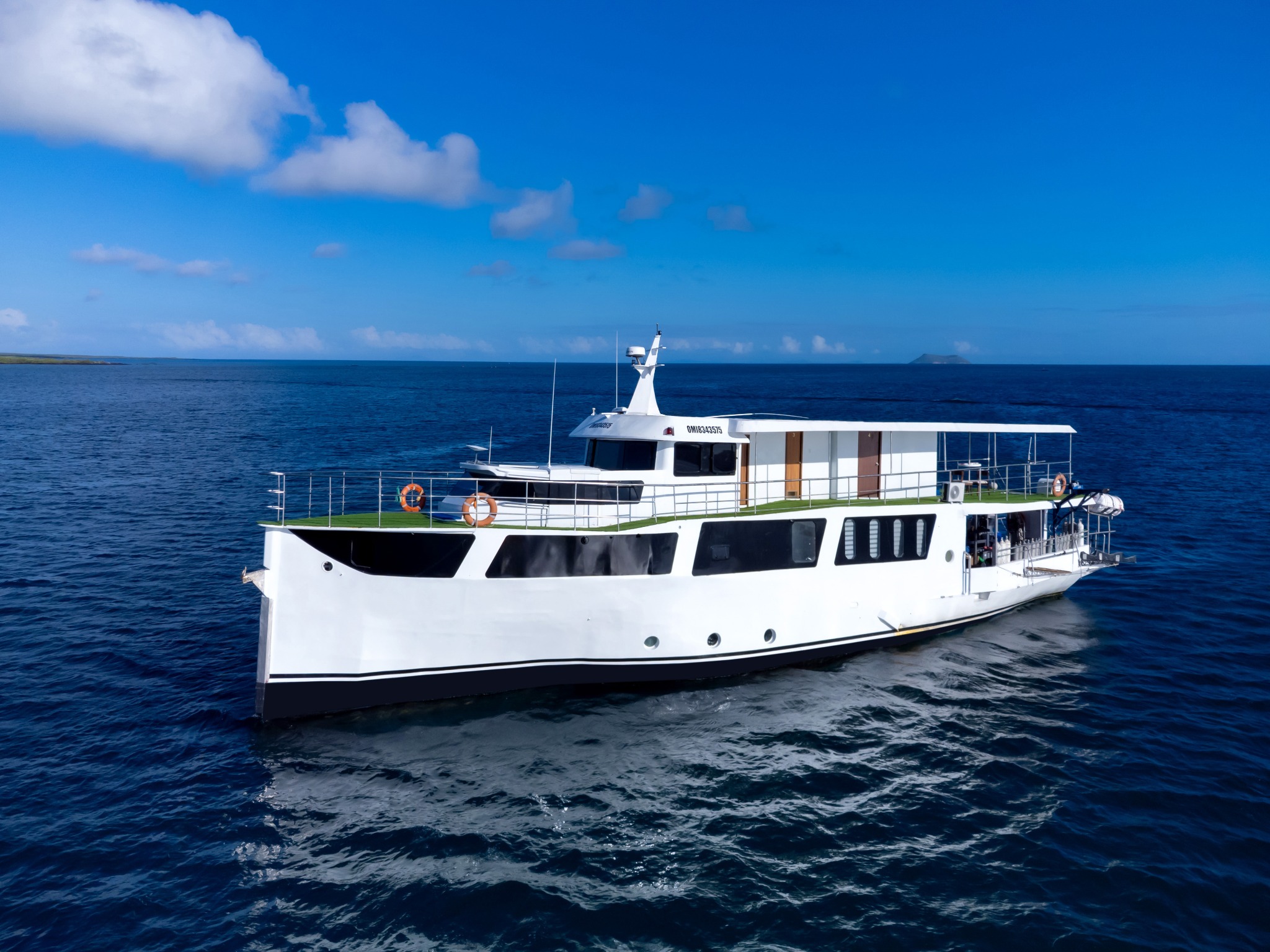
Danubio Azul Liveaboard, Galapagos
The Danubio Azul liveaboard offers a personalized and intimate diving experience, perfect for discovering the underwater treasures of the Galapagos Islands. With its small capacity, guests can expect dedicated and personal care throughout their journey.
Boat Interior
The Danubio Azul can accommodate up to 16 guests across its 9 cabins. Each room is equipped with private showers and air conditioning, ensuring a comfortable stay. The cozy open-air dining area is ideal for relaxing and socializing with fellow passengers. Additionally, the boat features a sun deck with panoramic views, perfect for enjoying the stunning Galapagos landscapes.
Dive Deck
The dive deck is spacious and designed for comfortable dive preparation. It is shaded and comes with storage boxes to keep your gear organized and secure.
Safety
Safety on board meets all international standards. The Danubio Azul is equipped with first aid kits, emergency rafts, life vests, fire alarms, and fire extinguishers. The crew is trained to handle emergency situations, ensuring a safe diving experience for all guests.
Itinerary
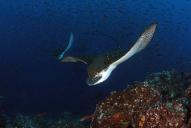
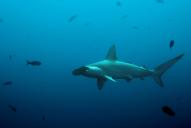
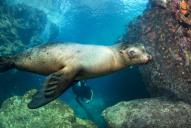
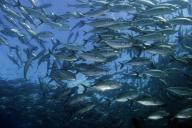
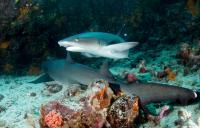
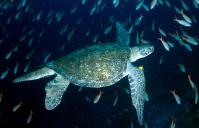
The itineraries of the Danubio Azul include diving at premier sites such as Santa Cruz Island, Bartholomew Island, Cousins Rock, Wolf Island, Darwin Island, and Isabela Island. These destinations are a diver’ s paradise, offering encounters with sea lions, penguins, seals, eagle rays, marine iguanas, hammerhead sharks, Galapagos sharks, sea turtles, golden rays, and whale sharks. The unique position of the Galapagos Islands at the convergence of several ocean currents brings a rich array of marine life.
When to Go
The Galapagos Islands feature two main seasons. The rainy season lasts from December to June, characterized by high humidity and temperatures ranging from 26-30° C (79-86° F). The cooler season runs from June to November, with temperatures between 20-24° C (68-75° F). Diving is possible year-round, but each season offers different marine life encounters and diving conditions.
For those searching for Galapagos liveaboard diving cruises, the Danubio Azul provides an ideal blend of comfort, safety, and extraordinary diving experiences. Whether you' re exploring the diverse marine life or relaxing on the sun deck, this liveaboard promises an unforgettable adventure in one of the world' s most renowned diving destinations
Cabins
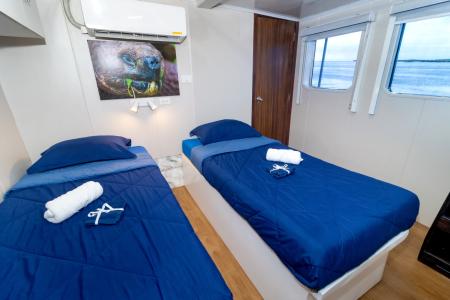
Cabin Twin / Double (# 1 & 4)
Cabin Twin / Double (# 1 & 4)
Cabin Twin / Double (# 1 & 4)
Deck:Upper Deck
Bedding:Double Bed or Twin Bed
Max occupancy:2 Guests
Number of Cabins:2 Cabins
Ensuite Bathroom: Yes
Aircon: Yes
- Towels
- Basic Toiletries
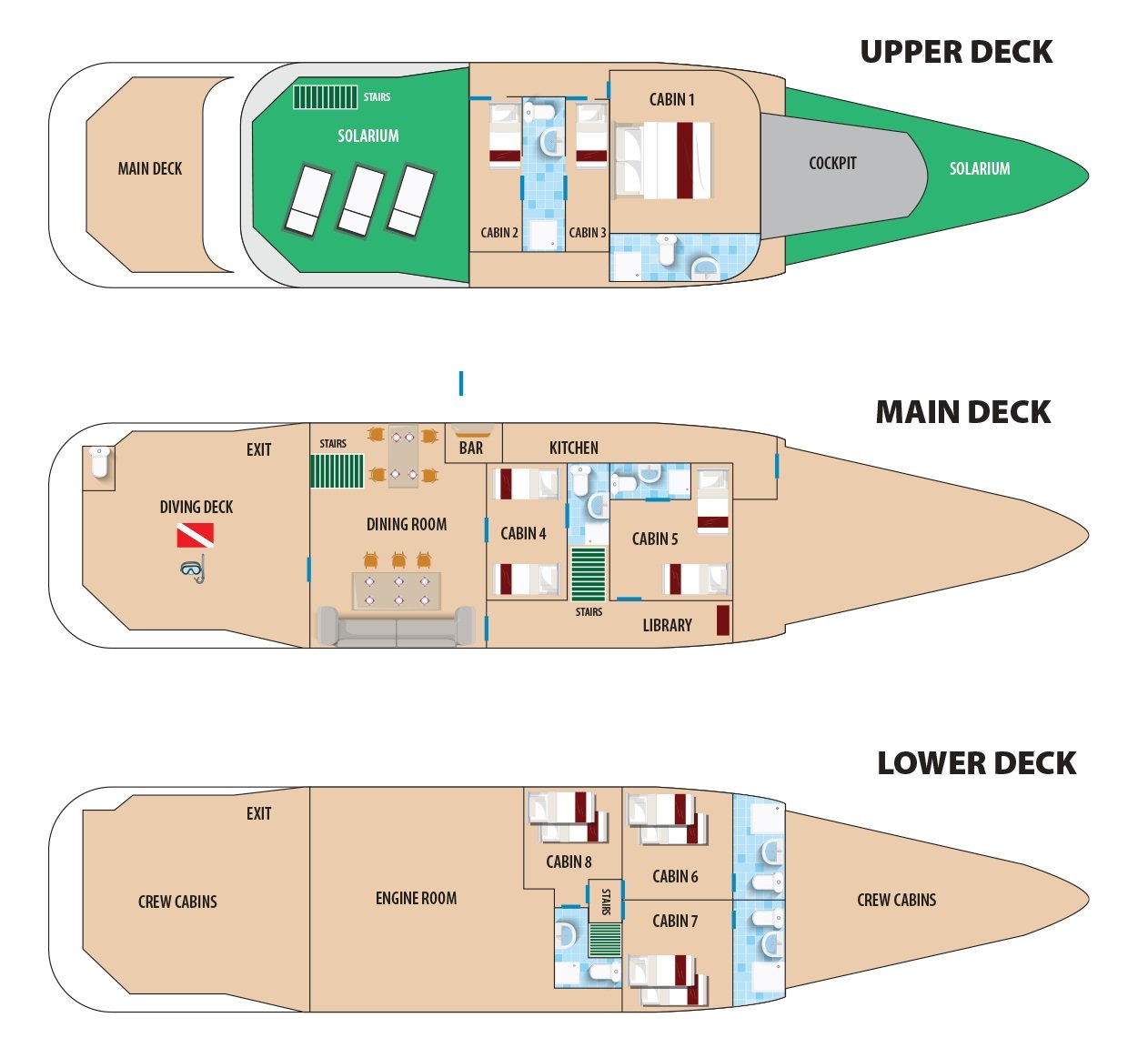
2 double cabins (cabin 1 & 4) with matrimonial beds or convertible to twins with windows and an ocean view
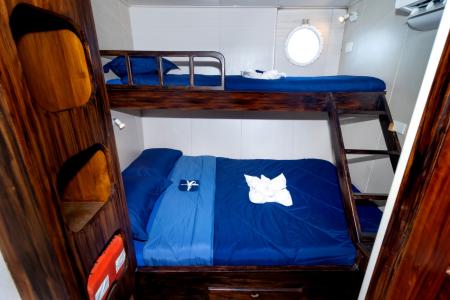
Bunk Bed Cabin (#7, 8 & 9)
Bunk Bed Cabin (#7, 8 & 9)
Bunk Bed Cabin (#7, 8 & 9)
Deck:Lower Deck
Bedding:Double Bed + Twin Bed (Bunk-Style)
Max occupancy:2 Guests
Number of Cabins:3 Cabins
Ensuite Bathroom: Yes
Aircon: Yes
- Towels
- Basic Toiletries
3 cabins with bunk beds, one double lower & one Single upper berth with private bathroom (cabins 7, 8 & 9) and portholes
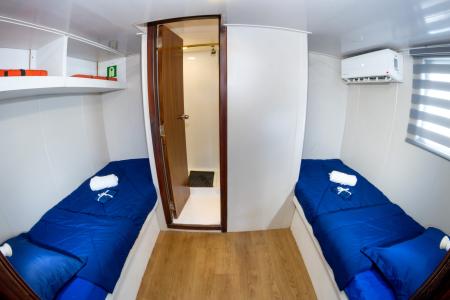
Twin Bed Cabin (# 5 & 6)
Twin Bed Cabin (# 5 & 6)
Twin Bed Cabin (# 5 & 6)
Deck:Main Deck
Bedding:Twin Beds
Max occupancy:2 Guests
Number of Cabins:2 Cabins
Ensuite Bathroom: Yes
Aircon: Yes
- Towels
- Basic Toiletries
2 twin cabins (cabin 5 & 6). Private bathroom, air conditioning, hot and cold water showers
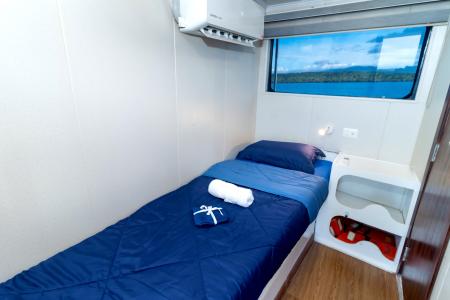
Single Cabin (# 2 & 3)
Single Cabin (# 2 & 3)
Single Cabin (# 2 & 3)
Deck:Upper Deck
Bedding:Single Bed
Max occupancy:1 Guest
Number of Cabins:2 Cabins
Ensuite Bathroom: Yes
Aircon: Yes
- Towels
- Basic Toiletries
2 single cabins ( Cabin 2 & 3) with windows and a private bathroom
Boat Specification
Dive Facilities
- Compressors
- Rinse Hosts
- Tenders for Diving
- Dive Deck
Boat navigation & safety
Full safety
Food & Drinks
- Western Food
- Local Food
- Dietary Restrictions
- Buffet Style
- Alcoholic Beverages and Spirits
- Hot & Cold Soft Drinks
- Snacks All Day
Onboard Facilities
- Onboard Kayaks
- Audio & Video Entertainment
- Air Conditioned Saloon
- Sun Deck
- Sun Loungers
- Open Air Saloon
- Indoor Saloon
- Bar
- Non-Diver (Snorkeler) Friendly
- Land Excursions
Danubio Azul Reviews
Similar Liveaboards
Danubio Azul Liveaboard Itineraries
Galapagos Islands (7 nights) (Baltra-Baltra)
Included
- Accommodation
- Diving (3-4 dives/day, 2 dives on the last day)
- Full board
- Soft drinks
- 12 l tanks and weights
- Dive guide
- Scuba safety equipment rental
- Snorkelling equipment rental
- Island visits and excursions according to the itinerary
- Free short-term DAN diving insurance (upon request)
Obligatory surcharges
- Galapagos National Park entrance fee - 200 USD per person (to be paid upon arrival)
- Transit Control Card - 20 USD per person (to be paid upon arrival)
- Chamber fee - 35 USD per person (to be paid on board)
Extra cost
- International and domestic flights
- Visa
- Transfers
- Equipment rental
- 15 l tanks rental
- Nitrox
- Alcoholic beverages
- Crew gratuities
- Travel insurance
Program
Day 1:
Meet & greet at the airport. Group transfer to the port. Onboarding, meeting the crew & briefing.
Santa Cruz.
AM: Arrive to Baltra Airport.
PM: Carrion Point.
This exotic place has one of the most pacific currents. The majority of species found here are the old chameleon and the gringo, old rainbow, chancho and pretty Galapagos gobio. This place is excellent for snorkeling and panga ride.
Day 2:
Isabela
AM: Cape Marshall
PM: Cape Marshall
It is a bottom of basaltic rock of very variable sizes and descends in a relatively steep slope towards greater depths. It is surprising that this background originated, through ground lava flows that went into the sea. Being in a megafauna pass area, this dive site is ideal for spotting stingrays, devil rays, green turtles, sea lions, different shark species and more open water species.
Cape Marshall is situated on the northeastern coast of Isabela Island, slightly south of the equator and near the base of the active Wolf Volcano. This area is known for its drift diving opportunities and features a nearly vertical wall of volcanic rock that plunges to the ocean floor. It’s an excellent spot to encounter hammerhead sharks, white-tipped reef sharks, and Galapagos sharks.
Day 3:
Darwin
AM: El Arenal
PM: Darwin’s Arch
Darwin’s Arch is a hotspot where sharks, turtles, and mackerels gather at cleaning stations, benefiting from a symbiotic relationship with butterflyfish, barber fish, and angelfish. The sandy slope in front of the arch, called “El Arenal,” is the busiest area, perfect for spotting hammerhead sharks, Pacific green turtles, and the occasional hawksbill turtle, along with garden eels and starfish. Beyond, sloping terraces lead to a deep
ravine with curved reef contours, offering excellent spots to watch hammerheads. Just 100 meters from Darwin’s Theatre, this area also provides opportunities to swim with whale sharks and enjoy the marine life carried by the current.
Darwin’s Arch is one of the most iconic landmarks in the Galapagos, but only a few travelers have the chance to see it in person. However, the true marvel lies beneath the waves, where the reef platform hosts a world-class diving experience. This underwater paradise is a hotspot for schools of scalloped hammerhead sharks and, most notably, whale sharks—the largest fish in the world, reaching the size of a bus. Divers can get remarkably close to these gentle giants, particularly between June and November. During this period, pregnant whale sharks often stop here on their mysterious migration, accompanied only by remora fish.
Day 4:
Darwin / Wolf
AM: El Arenal
PM: Punta Shark Bay
PM: 18:00-22:00 Darwin’s Arch
Darwin’s Arch is a hotspot where sharks, turtles, and mackerels gather at cleaning stations, benefiting from a symbiotic relationship with butterflyfish, barber fish, and angelfish. The sandy slope in front of the arch, called “El Arenal,” is the busiest area, perfect for spotting hammerhead sharks, Pacific green turtles, and the occasional hawksbill turtle, along with garden eels and starfish. Beyond, sloping terraces lead to a deep ravine with curved reef contours, offering excellent spots to watch hammerheads. Just 100 meters from Darwin’s Theatre, this area also provides opportunities to swim with whale sharks and enjoy the marine life carried by the current.
Shark Bay, located on the coast of Wolf Island, is a shallower dive site compared to its surroundings but often considered the most remarkable. It’s teeming with sharks and features vibrant cleaning stations that highlight fascinating symbiotic interactions. Hawksbill turtles and critically endangered Pacific green turtles frequently visit these stations, where royal angelfish also tend to painted rays and hammerhead sharks. In the shallow waters, male hammerhead sharks are more likely to approach stationary divers, unlike females in open water. Their calm demeanor contrasts with the playful Galapagos fur seals, which eagerly seek interaction with divers.
Day 5:
Wolf
AM: Punta Shark Bay
PM: El Derrumbe
PM: 14:00-18:00 Darwin’s Arch
Shark Bay, located on the coast of Wolf Island, is a shallower dive site compared to its surroundings but often considered the most remarkable. It’s teeming with sharks and features vibrant cleaning stations that highlight fascinating symbiotic interactions. Hawksbill turtles and critically endangered Pacific green turtles frequently visit these stations, where royal angelfish also tend to painted rays and hammerhead sharks. In the shallow waters, male hammerhead sharks are more likely to approach stationary divers, unlike females in open water. Their calm demeanor contrasts with the playful Galapagos fur seals, which eagerly seek interaction with divers.
The descent down a rocky slope leads to natural viewing spots on the edge of a cliff, around 20 meters deep. From these points, you can enjoy a breathtaking panorama into the blue, where one of the most spectacular shark displays in the Galapagos unfolds. While gripping the rocks, you’ll be surrounded by hammerhead sharks, along with Galapagos sharks, silky reef sharks, blacktip sharks, spotted stingrays, and schools of pelican barracudas. During the colder months (June to November), there’s a chance to encounter large whales, including orcas and humpback whales.
Day 6:
Isabela / Fernandina
AM: Vicente Roca Point
PM: Cape Douglas
Vicente Roca Point is situated at the mouth of the seahorse-shaped formation of Isabela Island, visible from space. As you enter a dark cave beneath a magnificent arch, the sounds of crashing waves reverberate through the air. Around the corner, the collapsed amphitheater of the Ecuador Volcano offers another stunning vista. The sheltered waters of the caves, protected from the ocean’s swell, are perfect for snorkeling with a variety of sharks, penguins, pufferfish, and even seahorses. It’s also common to spot sunfish here, and keep in mind that the waters tend to be colder, which is why penguins thrive in this area!
Douglas Cape offers exceptional chances to witness a diverse array of marine life, both above and below the water’s surface. As you gear up for your dive, you might spot Galapagos penguins, cormorants, and marine iguanas, all unique to the islands. Additionally, we will seek out the fascinating marine iguanas swimming and feeding on the rocks beneath the water. Other marine creatures you could encounter include red-lipped batfish, horned dogfish, sunfish, and even the possibility of spotting whales!
Day 7:
Santiago / Santa Cruz
AM: Cousin’s Rock
PM: Fausto Llerena Breeding Center
Cousin Rock, a symmetrical volcanic pyramid, emerges from the coastal waters of Santiago, about 5 km offshore. This rocky outcrop is a resting spot for wildlife like blue-footed boobies, brown pelicans, Galapagos sea lions, and penguins, often visible during boat trips. Beneath the surface lies a vast underwater cone, home to a vibrant marine ecosystem accessible only to divers and snorkelers. The site offers two main dive spots: a thrilling wall dive in the northeast and a ridge surrounded by terraced walls on the opposite side. Dive depths range from 12-30 meters, with currents varying from medium to strong. Water temperatures span 20-26°C from January to May and 16-20°C from June to December. Visibility ranges from 12-30 meters, and the plankton-rich waters often attract diverse marine life, including larger animals.
The Charles Darwin Research Station is home to tortoises ranging in size from 7.5 centimeters (hatchlings) to 1.2 meters in length. Different subspecies of tortoises interact with one another, and older individuals are accustomed to human presence, sometimes extending their necks to be gently touched. Hatchlings are kept at the station until they are four years old and strong enough to survive independently in their natural habitat.
Day 8:
North Seymour
AM: North Seymour Island
PM: Baltra – Flight Back To Quito Or Guayaquil
The visit to North Seymour is the best way of saying goodbye to the Galapagos. Following a dry landing at sunrise we will walk amongst the largest blue-footed booby colony of the Islands. It is likely that you will enjoy their dancing and singing to find a
mate. Not far from the dancers we have great and magnificent frigate birds nesting. The males inflate their pouches to attract the ladies that fly above them. Swallow tailed gulls and tropicbirds decorate the large basaltic walls of the island.
We will be back on board for breakfast at 8:00 and we have to be ready to check out at 9:00. It is always a good idea to do most of your packing the previous night so you can have a pleasant last early morning visit and a relaxed breakfast.
Check out from the yacht, group transfer to the airport.
Routes can be affected by adverse weather conditions and unforeseen events, force majeure or other similar reasons