- The Great Pacific Debate
- Galápagos vs. Cocos Island Diving Comparison Table
- The Biological Variety of the Pacific Giants
- Water Temperatures and Thermoclines
- Crossing Times and Travel Logistics
- Managing Strong Currents and Surge
- Seasonal Windows for Whale Sharks and Hammerheads
- The Verdict for the Big Animal Addict
- FAQ
For the advanced diver, the Pacific holds two names in higher regard than any others: the Galápagos Islands and Cocos Island.
Both are remote outposts where the currents are fierce, the water is unpredictable, and the biomass is legendary. Yet, despite their shared reputation for hammerhead schools and big-animal action, these two destinations offer fundamentally different journeys.
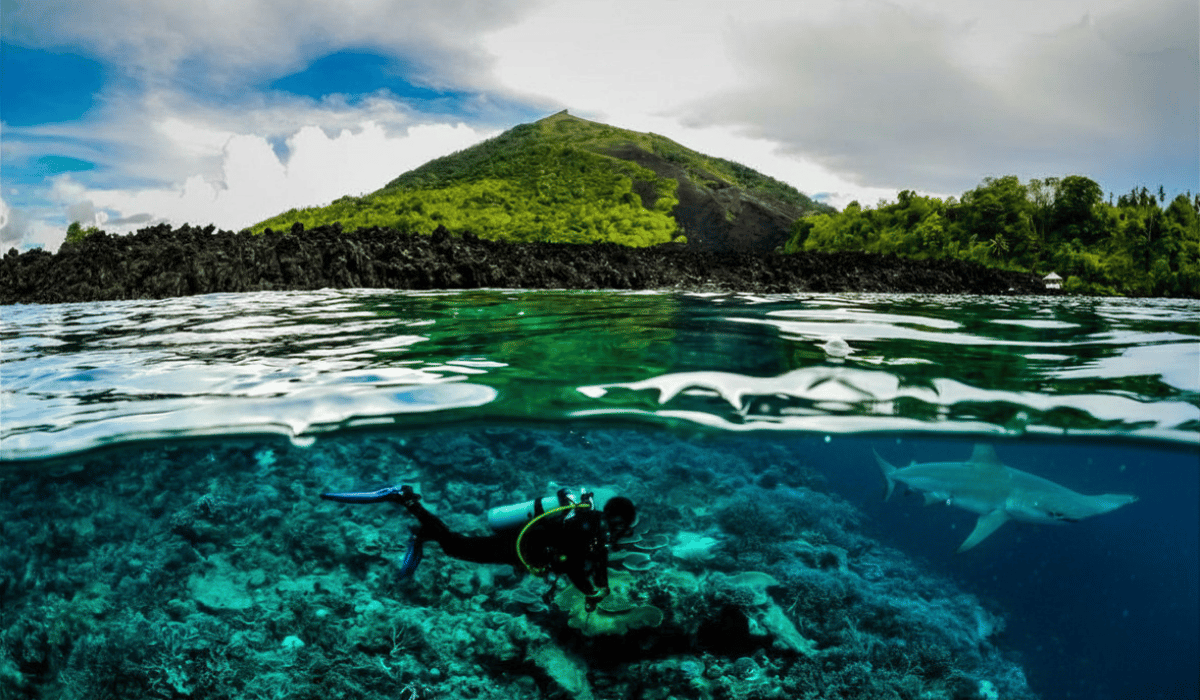
The Galápagos Islands are a sprawling living example of evolution where the wildlife is as famous above the water as it is below, whereas Cocos Island is a singular, vertical cathedral of sharks rising from the deep sea.
To help you decide where to drop your fins next, we’ve broken down the essential differences in Galápagos vs. Cocos Island diving so you can choose the legend that fits your soul.
The Great Pacific Debate
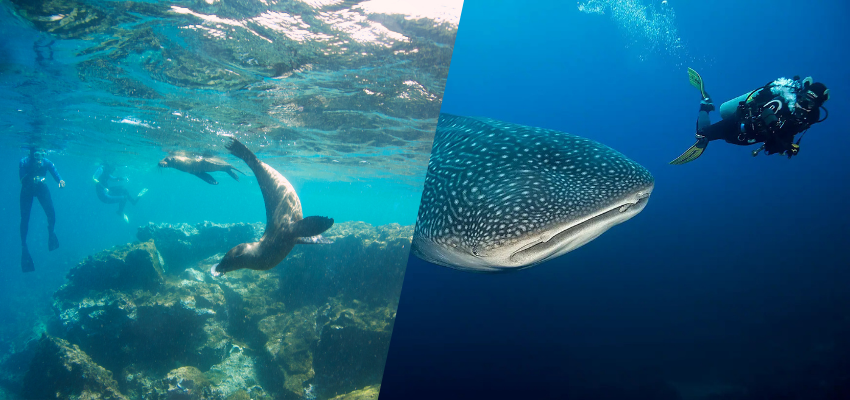
For many who have to choose, the question of Galápagos vs. Cocos Island diving is the most difficult one in the sport. These two destinations represent the pinnacle of blue-water exploration, yet they are often viewed as rivals for a diver’s limited time and budget. Both are remote volcanic outposts fueled by the nutrient-rich currents of the Pacific Ocean, and both serve as magnets for the largest congregations of hammerhead sharks on the planet.
In fact, these two icons are physically and biologically linked by the Cocos-Galápagos Swimway, a 120,000-square-kilometer underwater highway that follows the Cocos Ridge. This corridor is a vital artery for the very sharks and rays you have come to see, allowing them to migrate safely between the two UNESCO World Heritage sites.
The debate often begins with a simple question of accessibility. Galápagos is an archipelago of nineteen islands, accessible via a short flight from mainland Ecuador. This relatively easy access allows for a journey that transitions between the surreal volcanic landscapes on land and the high-energy action underwater.
Cocos Island, conversely, is a singular, uninhabited mountain peak rising from the abyss, located over 300 miles from the Costa Rican coast. Reaching it requires a committed 36-hour boat crossing, a rite of passage that immediately filters out the casual traveler in favor of the dedicated expeditionist.
While the “shark fix” is a shared trait, the narrative of the trips diverges quickly.
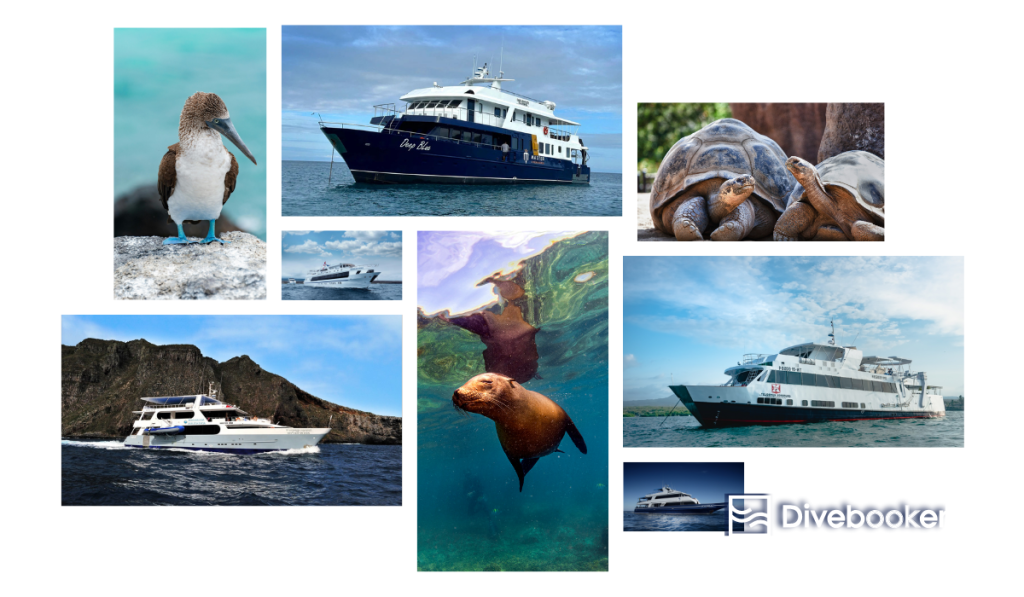
In the Galápagos, you are a witness to a unique endemic spectacle, where marine iguanas graze on algae and penguins dart through tropical waters.
At Cocos, the narrative is stripped down to its most intense elements. There are no towns, no airports, and no diversions. There is only the boat, the jungle, and a relentless focus on the massive schools of predators that patrol the island’s submerged ridges.
Understanding which destination is right for you requires looking past the shared headlines and examining the specific energy of the water itself.
Galápagos vs. Cocos Island Diving Comparison Table
For a quick overview of how these two Pacific legends stack up, refer to the table below. This high-level comparison highlights the primary differences in logistics, conditions, and the core underwater experience.
| Feature | Galápagos Islands | Cocos Island |
|---|---|---|
| The “Vibe” | “Darwin’s Living Laboratory” | “The Shark Arena” |
| Primary Location | 600 miles off Ecuador | 340 miles off Costa Rica |
| Access Point | Fly to Baltra or San Cristóbal | 36+ hour boat crossing from Puntarenas |
| Peak Season | June to November (Whale Sharks) | June to August (Hammerhead Schools) |
| Surface Activity | Land visits for giant tortoises, iguanas, and birds; varied island scenery. | Almost entirely boat-based. Possible short 1-2 visits to jungle waterfalls or viewpoints. |
| Water Temperature | Variable: 18°C–28°C (64°F–82°F) | Generally warmer: 24°C–29°C (75°F–84°F) |
| Dive Level | Advanced (Strong currents and surge) | Advanced (Deep water and strong currents) |
| Trip Duration | Typically 7 to 10 nights | Typically 10 to 12 nights |
| Signature Species | Whale Sharks, Scalloped Hammerheads, Marine Iguanas, Penguins, Mola Mola. | Hammerhead vortexes, Tiger Sharks, Galápagos Sharks, huge numbers of white tip sharks. |
| Dive Count | Often 4 dives per day | Limited to 3 dives per day |
| Park Fees | ~$200 USD (subject to change) | ~$490 USD plus 13% tax for a 10-night trip |
While you can access many Galápagos sites when land based, both destinations are exclusively the domain of liveaboards if you want to reach the most iconic sites, such as Darwin and Wolf in the Galápagos or Bajo Alcyone at Cocos Island. While they share a foundation of advanced, high-energy diving, the choice ultimately rests on whether you prioritize biological variety or pure predatory density.
The Biological Variety of the Pacific Giants
While both of these destinations are famous for their larger inhabitants, the actual variety of life you will encounter is quite different. Choosing between them often depends on whether you want a broad natural history expedition or a trip focused almost exclusively on pelagic predators.
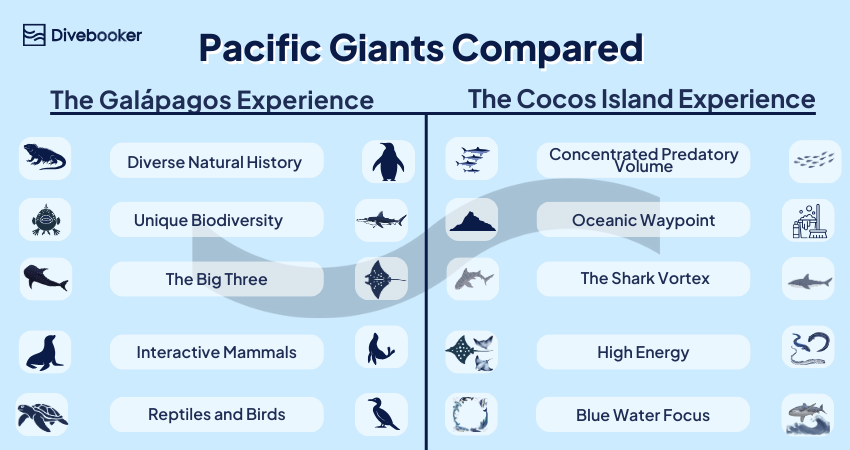
The Galápagos Ecosystem
The Galápagos Islands are often described as a living laboratory. Because of the convergence of several major ocean currents, the archipelago supports a unique mix of tropical and cold water species that you will not find anywhere else on earth.
- Endemic Wonders: This is the only place where you can watch marine iguanas graze on green algae or see the world’s only northern hemisphere penguins darting through the water.
- Macro and Reef Life: While the focus is usually on the big stuff, the rocky reefs are home to red-lipped batfish, bullhead sharks, and various species of seahorses.
- The Big Three: Most divers visit with the hope of seeing whale sharks, manta rays, and the iconic scalloped hammerheads in the Galápagos, especially around the northern islands of Darwin and Wolf.
Mammals: Sea lions are omnipresent and highly interactive, often following divers throughout their safety stops.
The Cocos Island Ecosystem
Cocos Island offers a more concentrated experience. It is a singular, lush mountain in the middle of the deep sea, which means it acts as a massive cleaning station and hunting ground for animals traveling across the open ocean.
- Predatory Density: If Galápagos is about variety, Cocos is about volume. You are likely to see hundreds of whitetip reef sharks swarming the bottom at night and massive schools of jacks that block out the sun.
- The Shark Vortex: Beyond the hammerheads, Cocos is a reliable spot for seeing tiger sharks, Galápagos sharks, and silky sharks. The interaction here feels more raw and high- energy.
- Rays and Eels: The island is famous for its enormous marble rays and free swimming moray eels that are often seen hunting alongside the sharks.
- Blue Water Focus: There is very little “small stuff” to look at here. The focus is almost always outward into the blue, waiting for the next wall of predators to emerge from the shadows.
It is a mistake to think of these populations as static. Satellite tagging by organizations like MigraMar has proven that endangered scalloped hammerheads, whale sharks, and green sea turtles treat this entire region as a single habitat. They utilize the Swimway to move between the nursery grounds of the Galápagos and the deep-sea cleaning stations of Cocos. This connectivity is why both destinations have been designated as a Mission Blue Hope Spot, a recognition of their critical importance to the health of the entire Pacific Ocean.
In the Galápagos, your dive logs will be filled with a wide range of different creatures, including reptiles and birds. You might see a mola mola in the morning and a flightless cormorant in the afternoon, spend one dive with a playful sea lion and the next watching a whale shark pass by. It is a destination for the diver who loves diversity.
At Cocos, the experience is more specialized. You are there for the sharks and the sheer biomass of the schools. While you may see fewer species overall, the number of individuals within those species is often much higher than anywhere else in the world.
Water Temperatures and Thermoclines
The liquid environment of these two destinations is shaped by massive oceanic currents that dictate everything from visibility to the presence of specific species. While both sit in the Pacific, the thermal experience for a diver is remarkably different.
The Galápagos Thermal Layering
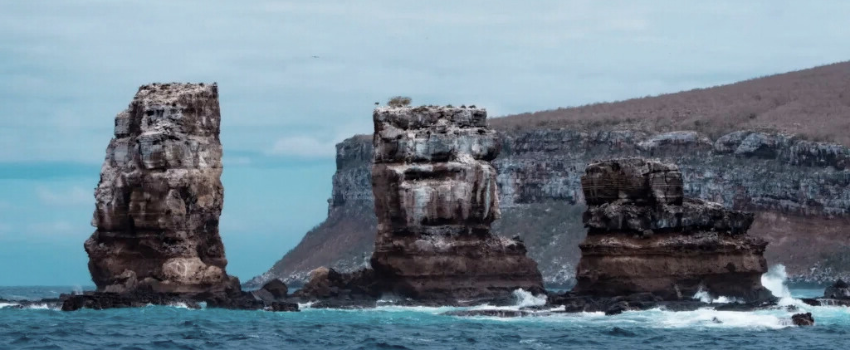
In the Galápagos, the water is a complex puzzle of moving parts. The cold, nutrient-rich Humboldt Current sweeps up from the south, clashing with the warmer Panama Current from the north. This results in a “cold-water tropics” environment that is famous for its dramatic thermoclines.
- Variable Conditions: Temperatures can swing from 18°C (64°F) to 28°C (82°F) depending on the island, the time of year, and the depth.
- Layered Waters: It is common to drop through a warm surface layer into a bone-chilling pocket of water at 15 meters, which is often where the most rewarding shark activity occurs.
- The Nutrient Factor: These cold upwellings are the reason for the archipelago’s high biodiversity, but they can also bring plankton blooms that temporarily reduce visibility.
The Cocos Oceanic Stability
Cocos Island is generally characterized by warmer and more consistent temperatures than its neighbor to the south. Because it is a singular pinnacle in the open sea, it is less affected by the conflicting archipelago currents.
- Warmth and Comfort: Most divers find Cocos much more comfortable, with average temperatures ranging between 24°C and 29°C (75°F to 84°F).
- The Trade-off: While the water is warmer, it is also very deep. Most of the action happens on submerged ridges where the currents can be quite powerful.
- Predictability: Conditions here tend to be more stable, offering reliable clarity and warmth that appeals to those who struggle with the cold.
Crossing Times and Travel Logistics

The logistical reality of these trips is a major factor in the decision-making process. One requires a focus on flight schedules, while the other demands a sturdy set of “sea legs” for a true open-ocean transit.
Reaching the Archipelago
Accessing the Galápagos is relatively straightforward but involves multiple steps. You will typically fly from the Ecuadorian mainland (Quito or Guayaquil) to the islands of Baltra or San Cristóbal. Once you land, the transit depends on what type of adventure you chose, liveaboard or land-based Galápagos diving.
The jump to the Galápagos liveaboard from the mainland is short, meaning you can often be in the water the same day. This makes the trip feel more like a traditional vacation with a clear beginning and end.
The Voyage to the Jungle Island
Cocos Island is an entirely different commitment. There is no airport on the island, and the only way to reach it is by boat from the port of Puntarenas in Costa Rica.
- The Transit: Prepare for a journey of 30 to 36 hours across the open Pacific. You aren’t just crossing empty water; you are traveling directly over the Cocos Ridge.
- The Experience: This crossing is a rite of passage for serious divers. While the modern liveaboards are comfortable, the crossing can be rough depending on the swell.
- Total Immersion: Once the boat anchors at Cocos, it stays there for the duration of the trip. You are isolated from the world, with nothing but the jungle-covered island and the sharks for company.
For those who enjoy the feeling of being truly “at sea,” the long voyage to Cocos is part of the allure. However, for those who prefer to maximize their time in the water and minimize their time in transit, the Galápagos provides a much faster route to the first dive.
Managing Strong Currents and Surge
Diving in these waters is often described as a physical sport rather than a relaxing drift. Both locations are essentially oceanic peaks that intercept powerful, deep-sea currents, creating a dynamic environment that requires focus and physical fitness.
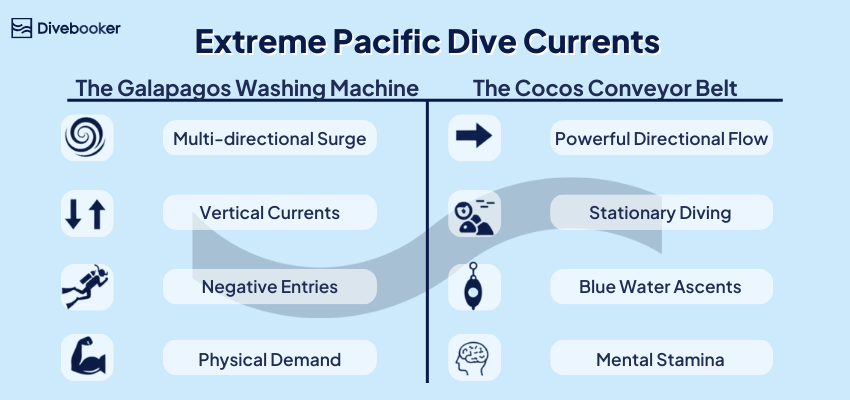
The Galápagos Washing Machine
In the Galápagos, the challenge often comes from a combination of strong currents and heavy surface surge. Because you are frequently diving near rocky outposts like Gordon Rocks or the vertical walls of Wolf Island, the movement of the water can be multi-directional.
- Surge and Swell: Near the surface and along the shallows, the Pacific swell can move divers back and forth several meters with every wave.
- Downcurrents: At the more advanced northern sites, divers must be prepared for unexpected downward or upward pulls.
- The Negative Entry: To avoid being swept away from the site, many dives begin with a negative entry, where you descend immediately upon hitting the water without inflating your BCD.
The Cocos Conveyor Belt
Currents at Cocos Island tend to be more directional and predictable, but they are incredibly powerful. The water here moves like a conveyor belt, bringing the schools of hammerheads directly to the cleaning stations.
- Holding Position: Much of the diving involves reaching a submerged rock or “station,” finding a secure handhold, and staying low to watch the action pass by.
- Blue Water Ascents: Because the currents can pull you away from the island quickly, many dives end in the open blue. Using a Surface Marker Buoy (SMB) is not just recommended here; it is a critical safety requirement.
- Mental Stamina: While the Galápagos is physically taxing due to surge, Cocos is mentally demanding because of the constant exposure to high-energy water and the need for perfect buoyancy control in the deep blue.
Seasonal Windows for Whale Sharks and Hammerheads
Galápagos: The Season of Giants
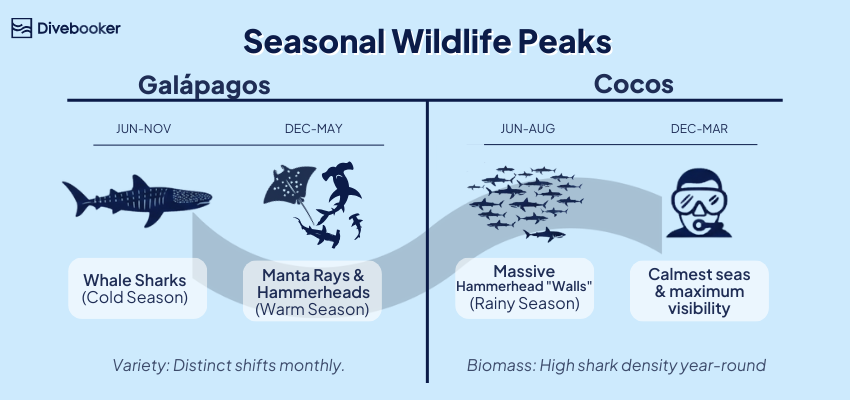
The Galápagos has two distinct seasons, each offering a different highlight for the diver.
- June to November (Cold Season): This is the time for whale sharks. The cold Humboldt Current is at its strongest, bringing massive, pregnant female whale sharks to the northern islands of Darwin and Wolf.
- December to May (Warm Season): The water is clearer and calmer. While whale sharks are less common, this is the best time for spotting large schools of hammerheads and manta rays in more comfortable temperatures.
For a deeper look at monthly temperatures, visibility, and wildlife sightings, you can explore our detailed guide on the best time to scuba dive in Galápagos Islands.
Cocos: The Hammerhead Peak
Cocos Island is less about seasonal variety and more about the intensity of the shark schools.
- June to August: This is widely considered the prime time for Cocos. The rainy season brings nutrient-rich water that attracts the largest “walls” of scalloped hammerheads.
- December to March: The seas are calmer and visibility is often at its best, though the sheer density of the hammerhead schools may be slightly lower than in the summer months.
Understanding the seasonal nuances for Cocos is just as important as it is for the Galápagos archipelago. Whether you are looking for the calmest crossings or the highest shark counts, matching your itinerary to the right month is the key to a successful expedition.
Regardless of when you go, it is important to remember that these are wild, open-ocean environments. While the seasons provide a reliable guide, the ocean often has its own schedule. It is this unpredictability that makes every dive in the Galápagos or Cocos feel like a true expedition.
The Verdict for the Big Animal Addict
Deciding between these two legends depends entirely on your personal diving philosophy and what you hope to see when you look into the blue.
Choose Galápagos if:
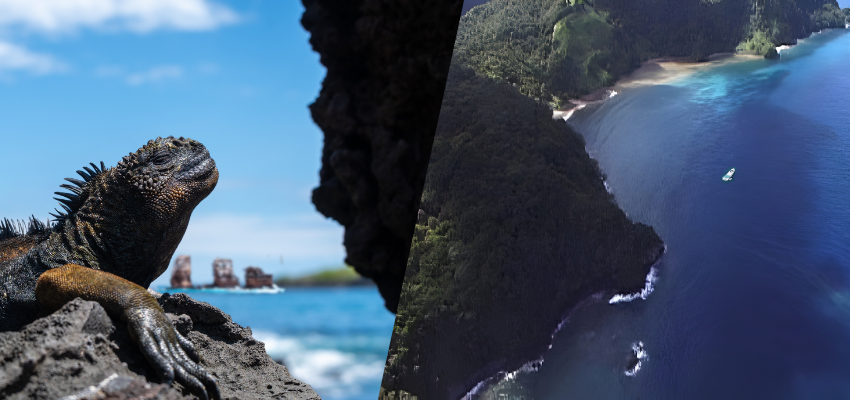
You are looking for a comprehensive natural history expedition. If you want to see the “big three” (whale sharks, hammerheads, and mantas) but also want to experience the strange, endemic life like marine iguanas and penguins, the archipelago is unbeatable. It offers a broader variety of species and a faster transition from the airport to the ocean. To fully prepare for the logistical nuances of this destination, you can read our comprehensive guide to Galápagos Islands Diving.
Choose Cocos if:
You have a singular obsession with sharks and want to be fully immersed in their world. Cocos is for the diver who doesn’t mind a 36-hour crossing if it means reaching a place where the human world completely disappears. It is for those who prefer warmer, more consistent water and want to see the highest possible density of hammerheads and tigers in a focused, high-energy environment.
FAQ
The transit from Puntarenas to Cocos Island typically takes 32 to 36 hours. It is a true open-ocean crossing that requires good “sea legs” and a sense of adventure.
Both are strictly for advanced divers, but the Galápagos is generally considered more technical. This is due to the unpredictable “washing machine” currents, heavy surface surge against volcanic rocks, and dramatic thermoclines that can drop the temperature by 10 degrees in seconds. Cocos is physically demanding due to the deep-water entries and strong directional currents, but the conditions tend to be more stable and predictable.
While a few specialized “combo” itineraries exist, they are marathons rather than vacations. A combined trip typically lasts 21 to 30 days and involves significant travel time between Costa Rica and Ecuador. For most divers, it is better to dedicate a full 10-day itinerary to one destination to truly experience its rhythm rather than rushing through both and risking “pelagic burnout.”
This depends on your definition of “better.” If “better” means variety, the Galápagos wins; you can see whale sharks, hammerheads, Galápagos sharks, and even the occasional silky or dusky shark in one trip. If “better” means intensity and proximity, Cocos takes the lead. The shark action at Cocos feels more “in your face,” with tiger sharks and massive schools of whitetips being a near-constant presence alongside the hammerheads.
It does not rule it out, but it requires a change in gear and mindset. If you are sensitive to the cold, you should aim for the Warm Season (December to May), when surface temps reach 28°C (82°F). However, be aware that the best “big animal” action often happens in the colder months. To enjoy the Galápagos year-round, most divers invest in a high-quality 7mm wetsuit, often supplemented by a hooded vest. In contrast, Cocos remains much more temperate and consistent, usually requiring only a 5mm suit.
In the luxury liveaboard market, both sit in a similar price bracket, but the logistical “extras” vary. A Galápagos trip usually involves a higher entry cost due to mandatory national park fees (currently $200 for most international visitors) and the necessity of domestic flights from the mainland. Cocos, while avoiding domestic flights, requires a stay in a San Jose hotel before the long transit and often has longer itinerary lengths (10–12 nights vs. 7 nights), which can increase the total price of the expedition.
Both are world-class, but the nature of the encounters differs. Cocos Island is often cited for the sheer consistency of its “hammerhead vortex.” Because the island acts as a singular, massive cleaning station in the open sea, you can often sit at sites like Alcyone or Dirty Rock and watch a continuous parade of sharks for an entire dive. In the Galápagos, the most massive schools are highly concentrated at the northern outposts of Darwin and Wolf. While the numbers there can be even higher, they are more dependent on specific current conditions on any given day.