The quick Google answer for the question of when the best time to dive the Red Sea is, is generally from March to May and from September to November, when water temperatures are comfortable, winds are calmer, and visibility is at its best across most of Egypt’s dive sites. That’s a reliable starting point, but the full answer to the Red Sea diving season is much more complicated and depends heavily on where you’re headed and what you’re diving for.
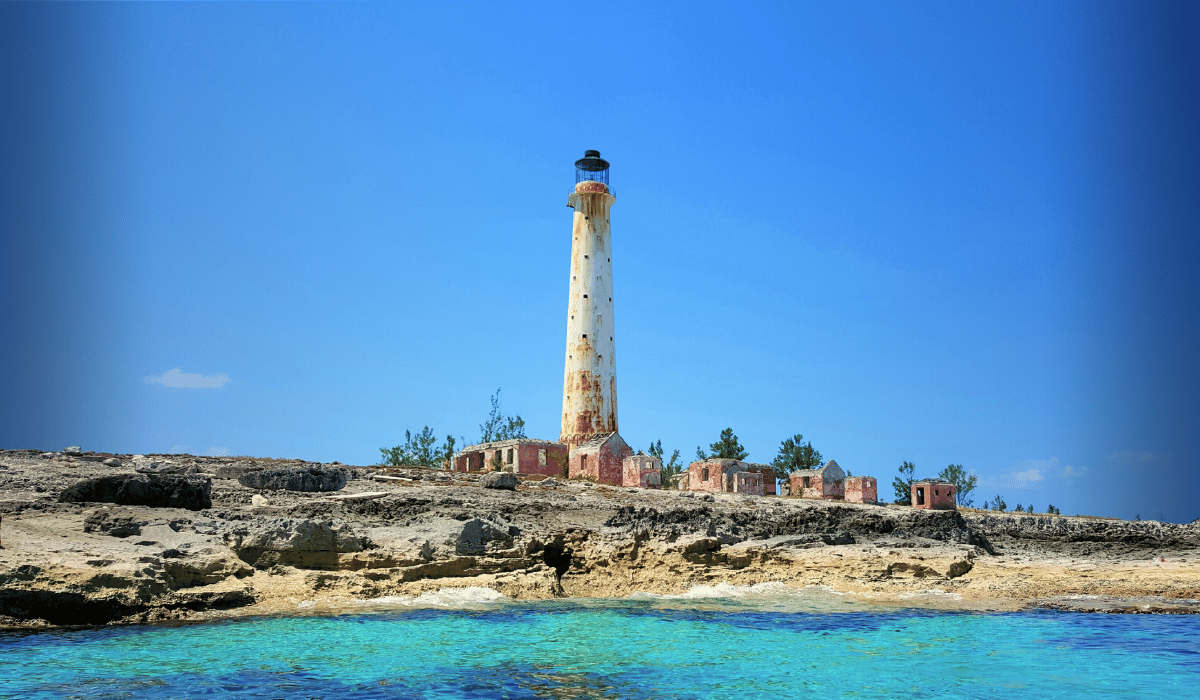
Egypt‘s Red Sea coast alone runs from Sharm El Sheikh’s reefs all the way down past Marsa Alam and Zabargad to the Sudenese border, encompassing the Brothers and Daedalus as well as St John’s in the deep south. Then there’s Saudi Arabia’s emerging dive scene and Djibouti‘s Gulf of Tadjoura (technically part of the Gulf of Aden, close to where it meets the Red Sea at the Bab-el-Mandeb Strait) and Saudi Arabia‘s emerging dive scene each follow their own calendar. If you’re chasing oceanic whitetips, hoping for whale sharks, or just want warm, calm water for a first Red Sea trip, timing shifts quite a bit by country and by priority.
This guide breaks the Red Sea diving season down by country, by the conditions that actually move month to month (temperature, wind, and visibility), and by what you want from the dive, whether that means sharks, wrecks, warm water, or an easier trip for a newer diver.
So, When Is the Best Time to Dive the Red Sea?
If you only have time to check one thing, start here. Spring (March to May) and autumn (September to November) are the sweet spots almost everywhere in the Red Sea. Water is warm enough for comfort, cool enough to avoid the harshest summer heat, and the sea is generally calmer.
| Country | Best months |
|---|---|
| Egypt | March–May & September–November (year-round diving possible) |
| Djibouti | November–February (whale shark season) |
| Saudi Arabia | March–May & September–November |
In short, aim for spring or autumn almost anywhere in the Red Sea. Shift your dates if you’re chasing Djibouti’s whale sharks or a shark-focused itinerary further south in Egypt.
Compare Red Sea diving trips to see what’s running each month.
Why Does Timing Matter So Much in the Red Sea?
You can dive in the Red Sea year-round, but three things move around enough from month to month that they’re worth understanding before looking at any single country or dive site.
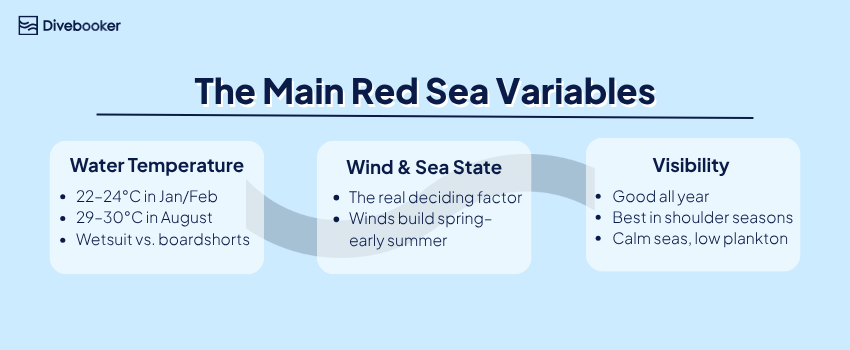
Water temperature swings more than many divers expect, from around 22 to 24°C in the coolest winter months (January and February) up to 29 or 30°C in high summer (August). That’s the difference between a 5mm semi-dry wetsuit and boardshorts, and it affects comfort on long or repetitive dives.
For many, wind and sea state usually matter more than temperature for trip planning. Prevailing northerly winds shape much of the Red Sea’s diving season, tending to build through the afternoon, especially from spring into early summer, and this pattern is most pronounced in Egypt and Saudi Arabia. It matters most for crossings to exposed sites like the Brothers, Daedalus, and Elphinstone, where a windy window can mean a bumpy ride even if the diving itself is excellent once you’re in the water. Djibouti’s Gulf of Tadjoura is more sheltered, so wind plays a smaller role there than it does further north.
Visibility in the Red Sea is good year-round by global standards, but it tends to peak when plankton levels are lower and seas are calmer, commonly in the shoulder seasons. Because these three factors move somewhat independently by country, the breakdown below looks at each destination on its own rather than applying one calendar to the whole Red Sea.
Red Sea Diving Season by Country
The Red Sea touches several dive-worthy countries, and each one runs on its own rhythm. Egypt is the dominant hub by far, so it gets the most detailed breakdown, while Djibouti and Saudi Arabia are each worth a closer look if you’re looking for something a little off the beaten path.
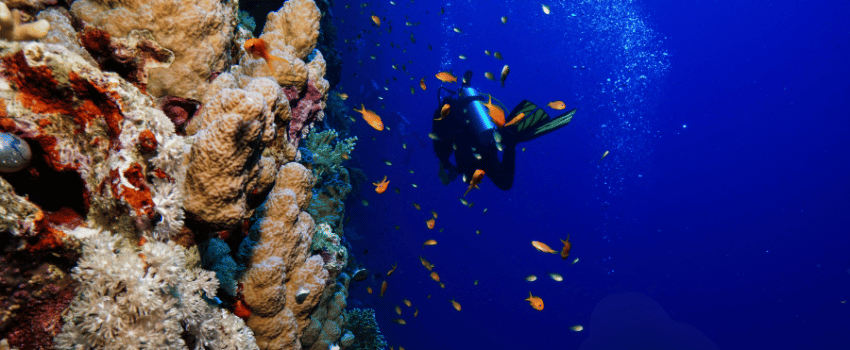
Egypt’s diving season breaks down fairly cleanly into four stretches, from a cooler, windier winter through to a warm, busy summer.
| Season | Water temperature | What to expect |
|---|---|---|
| Winter | 22–24°C | The windiest stretch of the year and quieter crowds. Good for divers who don’t mind a thicker wetsuit and want to skip peak-season pricing |
| Spring | 24–27°C | Widely considered the sweet spot: warming water, improving visibility, and winds that are usually more manageable than winter |
| Summer | 28–30°C | The warmest water of the year and the busiest season, especially with European travellers. Conditions are generally calm, but expect heat on the surface and crowded sites near Sharm El Sheikh and Hurghada |
| Autumn | 25–28°C | The other sweet spot, often paired with the tail end of shark season further south |
Visibility tracks the weather more closely than the calendar here, since it rarely rains and wind-driven waves tend to be the bigger factor. Even in winter, visibility often holds at 25 metres or better on calm days, and from spring through autumn it commonly runs from around 25 metres up to well over 30 metres when conditions are settled. Currents can pick up at exposed offshore sites like the Brothers, Daedalus, and Elphinstone regardless of season, so it’s worth checking conditions with your operator if you’re a newer diver.
This pattern plays out a little differently by region. Hurghada and Marsa Alam tend to be more sheltered and forgiving through most of the year, while Sharm El Sheikh and Dahab in the north can feel the wind more in spring. Further south, the Brothers, Daedalus, and Elphinstone, St. John’s, and Fury Shoals are more exposed, so comfort on the crossing depends heavily on the wind patterns above. Our guide to diving the deep south of the Egyptian Red Sea goes into more detail on that region, and Diving Elba Reef covers one of the more overlooked far-south sites.
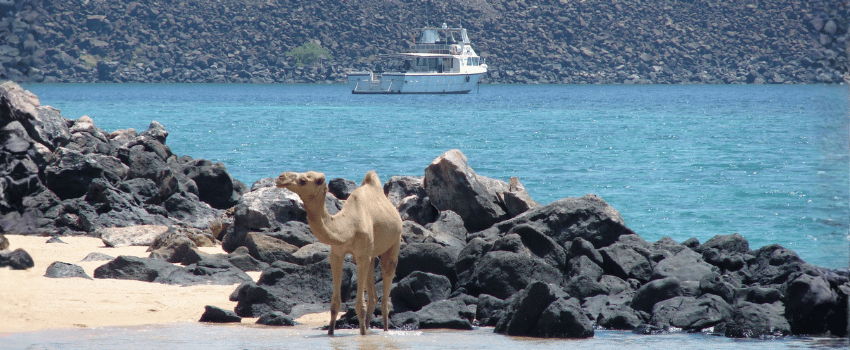
Djibouti runs on a different calendar entirely, built around whale sharks gathering in the Gulf of Tadjoura, typically from November to February. Diving is still possible outside that window, but most visitors time their trip specifically around whale shark season. Nature seldom delivers what you want it to on demand, so spending several days in the water improves your odds. Water temperature runs roughly 25–27°C in winter (December–February), warming to 28–30°C for the rest of the year, and the Gulf of Tadjoura’s sheltered bay usually keeps sea conditions calmer than the open Red Sea. Visibility generally sits in the 10–20 metre range, though it can dip toward the lower end during peak whale shark season, since the same plankton blooms that draw the sharks also reduce clarity. Researchers have documented the environmental drivers behind these seasonal aggregations in the Gulf of Tadjoura. For more on the diving in the area, look at our Diving in Djibouti page.
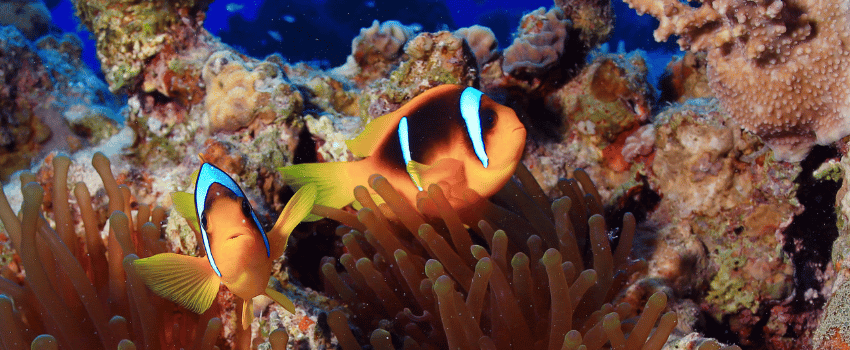
Saudi Arabia’s Red Sea coast is still an emerging destination, but it broadly follows northern Egypt’s pattern. Spring and autumn bring the most comfortable combination of warm water and manageable wind, while summer is hot and winter is cooler and windier. Water temperature runs roughly 24–26°C in winter up to 29–31°C in summer, and visibility is generally good year-round, often reaching beyond 30 metres in the calmer spring and autumn months. The reefs here see far less traffic than Egypt’s, with healthy coral cover, though dive tourism infrastructure is still developing. As this infrastructure and access continue to develop, it’s worth checking current operator schedules closely, since the season here is less standardized than in Egypt. Explore diving in Saudi Arabia for the latest options.
Best Time for Specific Interests
Best Time for Shark Diving in the Red Sea
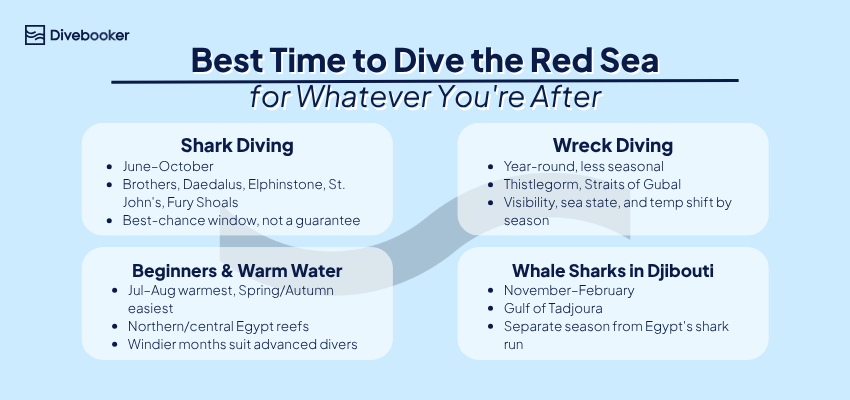
Egypt’s hammerhead and oceanic whitetip seasons are two distinct windows that overlap, particularly around the offshore trio of Brothers, Daedalus, and Elphinstone. From May to June, hammerheads show up in good numbers and sit relatively shallow, typically 15 to 20 metres. Through July and August, hammerhead schools tend to grow bigger but move deeper, often 25 to 40 metres. By September and October, cooling surface water brings hammerheads back into shallower water, though in smaller numbers, while oceanic whitetips start arriving in more consistent numbers as the water cools. This autumn window is generally the best average chance of seeing both species on the same trip, though it can happen earlier, especially further south for oceanics, and oceanic whitetip sightings then tend to continue fairly steadily through November and sometimes into December.
Shark activity elsewhere in the Red Sea is far less documented. Saudi Arabia’s more remote reefs occasionally report similar pelagic species, though with far fewer years diving behind them than Egypt’s, they are less predictable. Djibouti’s own shark draw, whale sharks, run on a separate calendar covered below. As with any wildlife encounter, treat this as a best-chance window rather than a guarantee. Our roundup of the best wrecks in the Red Sea and diving at Brother Islands both touch on how shark encounters and wreck diving often overlap on the same itineraries.
Best Time for Wreck Diving
Northern Red Sea wreck diving, including the Thistlegorm and the wrecks around the Straits of Gubal, is much less seasonally restrictive than shark diving. What changes with the seasons is mainly visibility and sea state, plus water temperature on longer penetration dives in winter. Egypt remains the Red Sea’s best-known wreck diving destination by far, but it isn’t the only one: Saudi Arabia’s coast holds a number of lesser-documented wrecks that are only beginning to attract attention as access and dive infrastructure develop there, covered in more detail in our guide to Red Sea wrecks. For now, it’s more of an exploratory option than an established circuit. Our guide to wreck diving destinations covers wreck-focused trip planning more broadly, useful if you’re weighing where to go next.
Whatever you’re chasing, browse Egypt’s shark and wreck sites before locking in dates, since the specialized itineraries above can book out early in peak windows.
Best Time for Beginners and Warm-Water Comfort
If comfort in the water is your priority, summer (July and August) delivers the warmest water of the year, while spring and autumn offer a good balance of warmth, calmer seas, and better visibility, generally the easiest combination for beginner and less experienced divers. Windier, current-heavy months tend to suit more advanced divers better. Our notes on good destinations for new divers and where to go after your Advanced course can help match your experience level to the right timing.
Whale Sharks in Djibouti
If you want to see whale sharks in the area, then it’s all about Djibouti. The Gulf of Tadjoura’s whale shark season runs roughly from November to February, entirely separate from Egypt’s general shark season further north. Most encounters here are with juvenile whale sharks drawn in by seasonal plankton blooms in the bay, and it’s typically an in-water, near-surface encounter rather than a deep dive, which makes it accessible to a wide range of experience levels, including confident snorkellers. Because the Gulf of Tadjoura is a relatively compact, sheltered bay, boat trips out to find the sharks tend to be short and calm compared to a typical Red Sea liveaboard crossing. Operators generally follow in-water guidelines meant to protect the animals, such as keeping a respectful distance and limiting group sizes around any one shark. As with any wildlife encounter, sightings are never guaranteed on a given day, so ensuring multiple dive days improves your odds.
Red Sea Liveaboard or Land-Based: Which Suits Your Season?
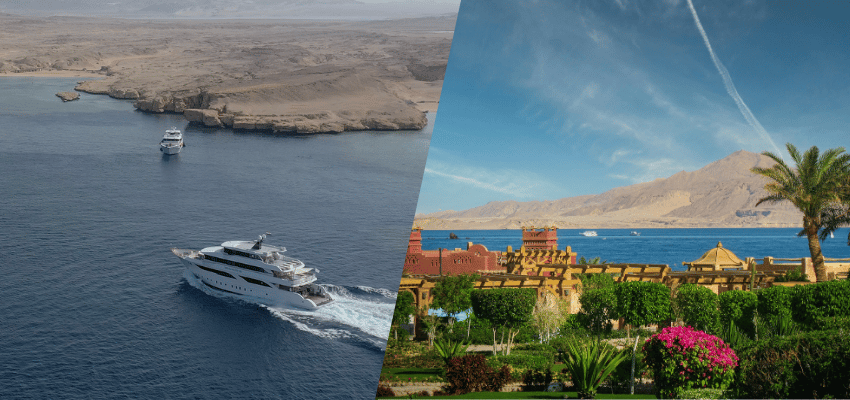
This is really a question of comfort during crossings, as much as where you want to dive. Land-based diving from Hurghada, Marsa Alam, or Sharm el-Sheikh stays fairly consistent through most of the year, and day boats can often adjust routes around the wind on any given day.
Liveaboards heading to more exposed offshore sites, such as the Brothers, Daedalus, Elphinstone, and St. John’s, depend more on settled sea conditions for the crossing itself. Spring and autumn tend to offer the smoothest routes to these sites, while winter’s stronger winds can make crossings choppier, even if the diving once you arrive is unaffected. In fact, many liveaboards do not offer the offshore sites during the winter months. Summer crossings are usually calmer, but hot on the surface. If a smooth crossing matters more to you than saving a few degrees of water temperature, that’s the trade-off worth planning around.
For more on how routes shift by season, see our overview of top liveaboard destinations and diving the Red Sea from a liveaboard in Egypt.
Conclusion
As a year-round diving destination, there’s no single best time to dive the Red Sea that works for everyone, but if you’re planning around Egypt or Saudi Arabia, spring (March to May) and autumn (September to November) are the safest bet for a comfortable balance of warm water, manageable wind, and good visibility. Djibouti is the outlier: plan for November to February if whale sharks are the goal. Beyond the calendar, let your priorities decide. Sharks mean June to October in Egypt’s south, wrecks are forgiving almost any time of year, and beginners will usually have the easiest time in the shoulder seasons.
Frequently Asked Questions About Diving the Red Sea
Wind is one of the biggest variables in Red Sea diving, particularly for crossings to exposed offshore sites. Conditions are generally calmest in spring and autumn, while winter tends to bring the strongest and most persistent winds. Local conditions can vary year to year, so it’s worth checking closer to your travel dates.
Wreck diving in the northern Red Sea, including popular sites near the Strait of Gubal, isn’t as seasonally restricted as shark or whale shark diving. Visibility and sea state are typically at their best in spring and autumn, and cooler winter water is worth planning for if you’re doing longer or more technical penetration dives.
Spring (March to May) and autumn (September to November) are usually the easiest windows for newer divers, thanks to the combination of warm water, calmer seas, and clearer visibility. Summer’s warm water is also beginner-friendly, though it’s the busiest and hottest season. Windier months and current-heavy sites in the south generally suit more experienced divers better.
Water temperature in Egypt’s Red Sea typically ranges from around 22 to 24°C in winter (January and February) up to 29 or 30°C in summer (August), with spring and autumn sitting comfortably in between. DAN’s notes on the Southern Red Sea are a useful reference for how temperature and conditions shift further south.
Egypt‘s shark season is commonly discussed as running from roughly June to November, centred on offshore sites like the Brothers, Daedalus, Elphinstone, St. John’s, and Fury Shoals. Sightings of oceanic whitetips and hammerheads are more likely in this window, but as with any wildlife encounter, nothing is guaranteed on a given day.
Yes, most of the Red Sea, especially Egypt, offers diving year-round. Conditions shift by season rather than shutting down: winter brings cooler water and more wind, summer brings heat and calmer seas, and spring and autumn balance the two. Djibouti is the exception, since its main draw, whale sharks, is tied to a specific window.
There’s no single perfect month for the whole Red Sea, but April, May, September, and October are commonly considered the strongest all-round choices in Egypt, combining warm water, manageable wind, and good visibility. If you’re diving Djibouti for whale sharks, November through February is the range that matters.