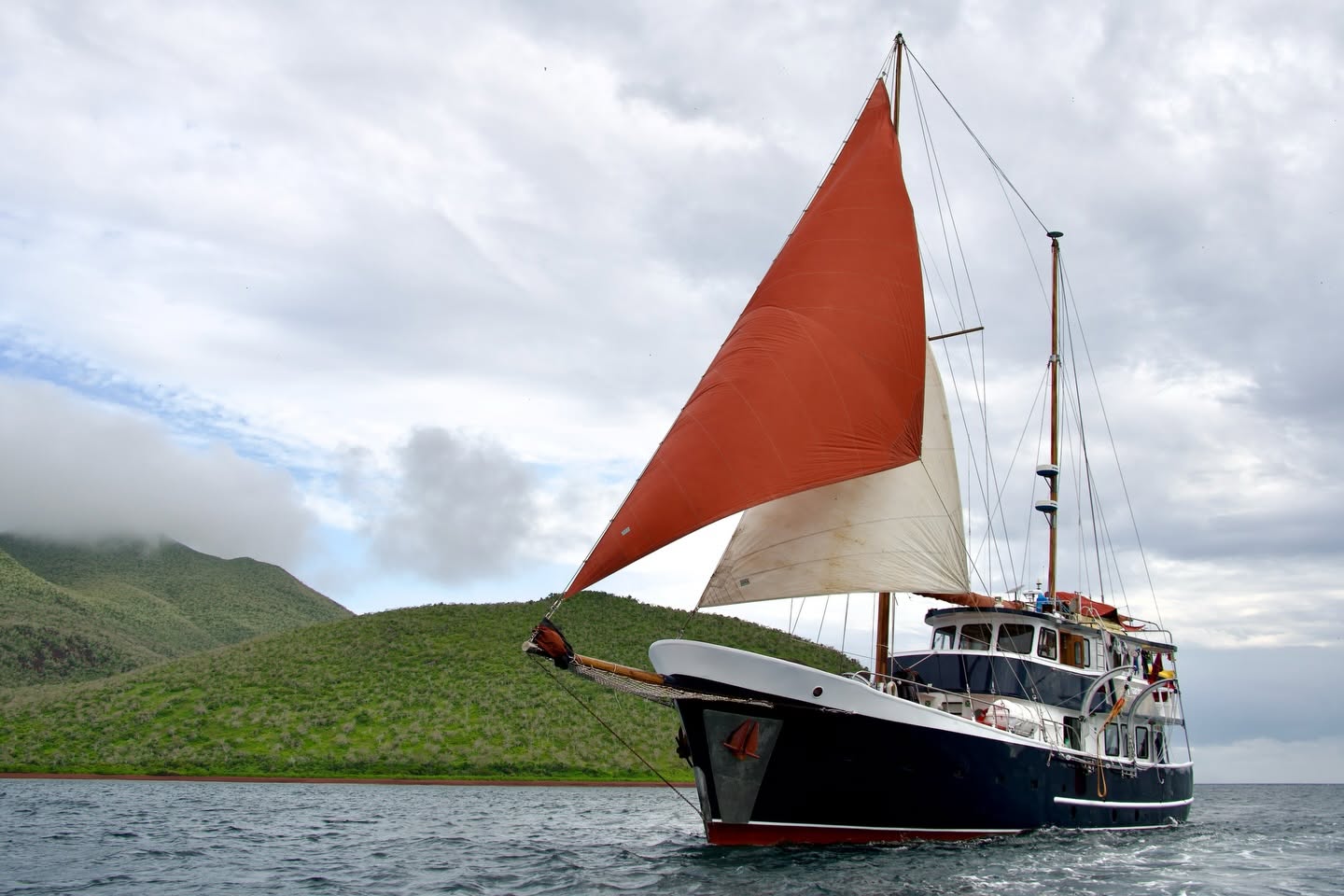
Samba Liveaboard, Galapagos
Cabins
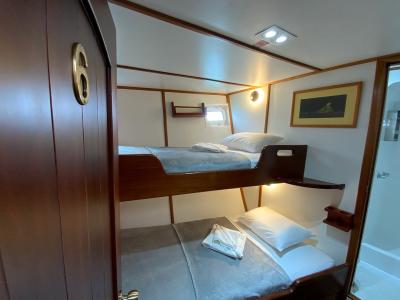
Double Cabin
Double Cabin
Double Cabin
Deck:Lower Deck
Bedding:Twin Beds (Bunk-Style)
Max occupancy:2 Guests
Number of Cabins:6 Cabins
Ensuite Bathroom: Yes
Aircon: Yes
Down below inside the hull, the Samba provides very comfortable beds in 6 double cabins. 6 air-conditioned double cabins and 1 exterior double bed cabin, all with private bathrooms and hot water
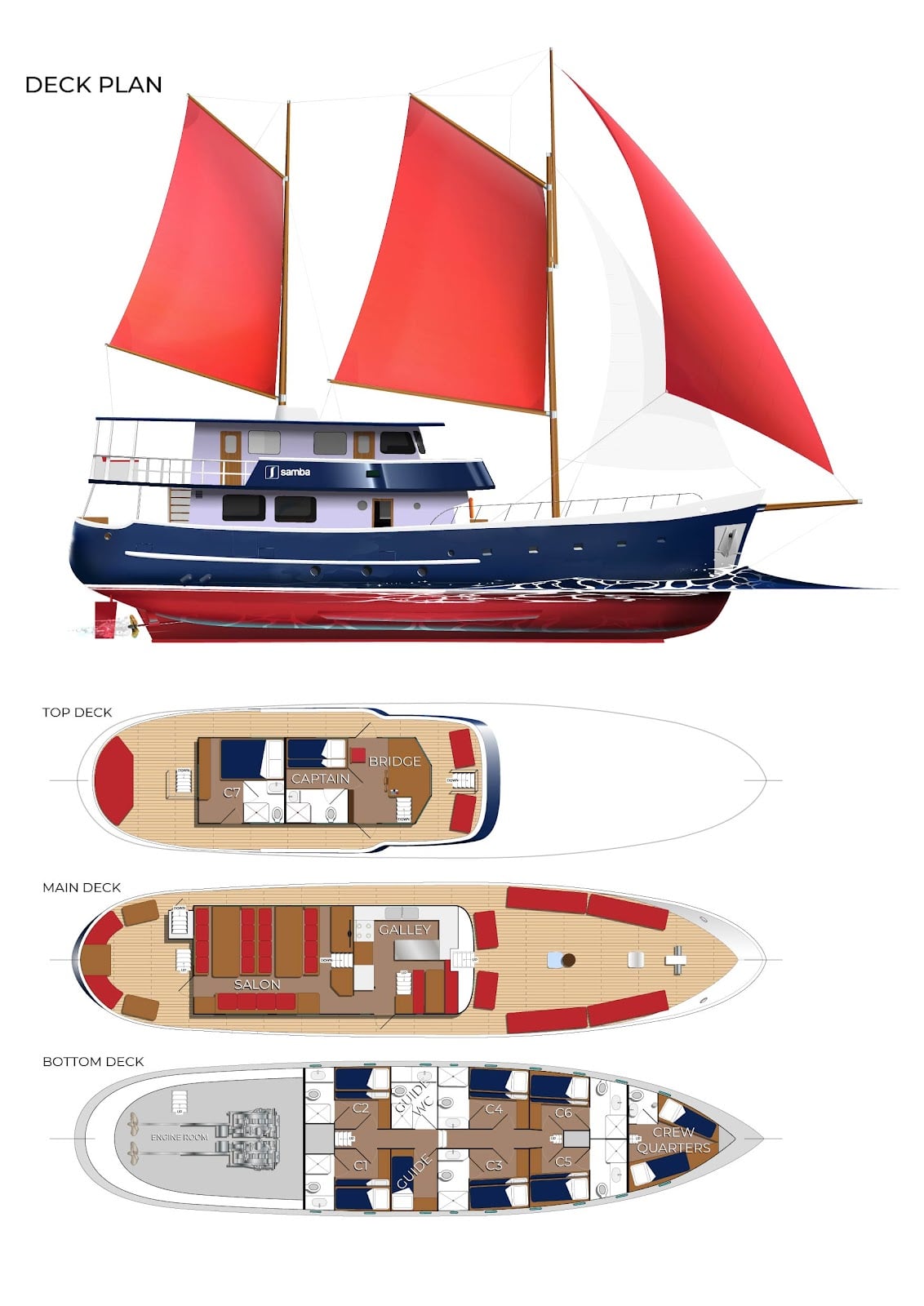
Boat Specification
Boat navigation & safety
Full safety
Onboard Facilities
- Audio & Video Entertainment
- Air Conditioned Saloon
- Sun Deck
- Open Air Saloon
- Indoor Saloon
- Bar
- Land Excursions
Similar Liveaboards
 GalapagosGalapagos Aggressor IIIfrom
 GalapagosTiburon Explorerfrom
 GalapagosGalaxy Diver IIIfrom
 GalapagosNortadafrom
 GalapagosGalapagos Skyfrom
 GalapagosDanubio Azulfrom
 GalapagosGalaxy Diver IIfrom
 GalapagosGalapagos Aquafrom
 GalapagosGalapagos Masterfrom
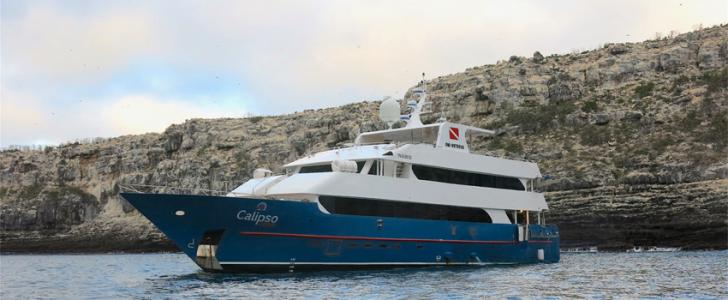 GalapagosCalipsofrom
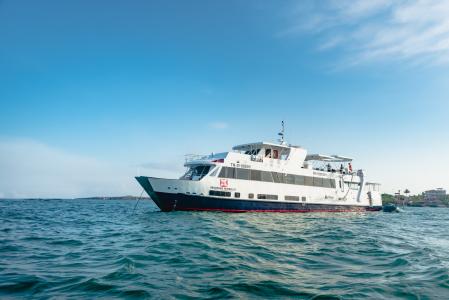 GalapagosHumboldt Explorerfrom
Samba Liveaboard Itineraries
North & West Itinerary (7 nights) (Baltra-Baltra)
Program
Tuesday
AM: Baltra Airport
PM: Mosquera
Upon arrival at Baltra Airport, all visitors pay their entrance fee to the Galápagos National Park, pass through immigration control, purchase their bus tickets, claim their checked luggage, and have their hand luggage checked by the Galápagos Biosecurity Agency (ABG, also known as the quarantine system). The Samba’s naturalist guide will assist you as you come out of the terminal and accompany you on the short bus ride to the harbour to board the Samba. Lunch will be served around 12:30.
After a light lunch, the Samba will navigate for 45 minutes to Mosquera. Imagine a beach rising from the ocean floor in the middle of nowhere, with sand grains as soft as sugar. Now imagine a sea lion colony and a fabulous sunset. You are here. Mosquera Islet is by far the best beginning to a Galápagos journey. This volcanic uplift dates back 100,000 years and is a geological treasure for an admirable start. On the shore, it is easy to encounter Galápagos sea lions, Sally Lightfoot crabs, and shorebirds.
Wednesday, Tower (Genovesa)
AM: Darwin Bay
PM: Prince Philip’s Steps
After 6 to 7 hours of navigation from Santa Cruz, you will wake up to the beautiful cacophony of one of the largest tropical seabird colonies on the planet. The cliff tops are decorated with frigatebirds, red-footed boobies, Nazca boobies, swallow-tailed gulls, tropicbirds, and many other pelagic animals. Darwin Bay is home to many of these nesting seabirds.
Following a wet landing and in the early morning light, you will blend in with the red-footed boobies displaying for potential mates as they collect nesting material. The great frigatebirds inflate their gular sacks, hoping to attract a female, while others play their favourite game: piracy. Darwin’s finches, Galápagos doves, and mockingbirds stroll the ground to find seeds and insects. The red mangroves, cactus, and saltbushes contrast with the blue sky and the dark basaltic walls.
Following lunch, you will do a dry landing to climb Prince Philip’s Steps. The steep ascent takes you 100 feet above sea level, where you are welcomed by the elegant silhouette of red-billed tropicbirds and the aerobatic Galápagos shearwater as they interact with the precipice on fast approaches. The lava rock trail takes you through the endemic dwarf incense tree forest, where you can find more red-footed boobies nesting and many of their gannet-like relatives, the Nazcas, loudly claiming the floor as their residence.
The Palo Santo forest is dormant most of the year, awakening in the rainy season and filling the air with a refreshing aroma. As you exit the latent trees, your breath may catch as you view the panorama with thousands of storm petrels flying erratically beyond the lava flows. This is the perfect scenario for the island predator to make a successful kill. The short-eared owl, known elsewhere around the world as a nocturnal predator, hunts in bright daylight on Genovesa. More cat than owl, it waits patiently outside lava tunnels and crevices to capture storm petrels as they leave their homes after feeding their young.
Snorkelling on Tower offers views of a wide variety of tropical fish.
Thursday, Marchena (Bindloe)
AM: Punta Mejía
PM: Playa Negra
All boats travel back south after sailing to Tower; the Samba is the only one heading west-northwest. The Galápagos National Park Service granted access to Marchena’s magical shorelines for snorkelling, dinghy rides, and kayaking. The forbidding, endless, and untouched lava flows, where only science has reached land, have no fresh water and very little precious soil. Bindloe’s serene setting is awakened only by the murmur and surge of the Pacific swells and the musical argument of castaway sea lions.
Punta Mejía is one of the best sites in the archipelago for snorkelling. The calm, clear, deep blue water of the northwest coast, combined with the dark, hostile topography of the island, gives the sensation of witnessing the beginning of our planet and its underwater world. Apart from great fish diversity, rays, reef sharks, and sea turtles are often seen while snorkelling.
Navigating southwest for 45 minutes to Playa Negra is always an exciting experience. More than once, bottle-nosed dolphins, other cetaceans, or feeding frenzies have been seen. After an early afternoon snorkel around a recently formed lava grotto where marine iguanas feed, the boat begins a 5–6-hour sail to the west.
As the vessel moves farther away from the island, the seafloor changes dramatically and enters deep water, an oceanic drop-off. The Cromwell Current, which arrives from the west from very productive waters, brings richness to the surface and generates a strong upwelling. As a result, there are positive effects throughout the marine food chain, and there is a good track record of seeing cetaceans and other ocean wanderers on this navigation. Whales and dolphins are never guaranteed, but every effort will be made to find them.
Friday, Isabela (Albemarle)
AM: Punta Albemarle
PM: Punta Vicente Roca
Human history has left its footprint on this small corner of the Galápagos. Punta Albemarle, the northernmost point of Isabela, was one of three important US radar stations used to prevent a Japanese attempt to destroy the Panama Canal. A small and deteriorated building is the last reminder of the boredom and routine that rusted the minds of the young navy officers. The soldiers were in charge of three-week shifts during which they never saw any action.
Nevertheless, the wildlife gives the best example of the constant struggle for survival, a fight where only the fittest continue. The recent lava flows are the nesting ground of the only flightless cormorant in the world and the basking terrain of the largest marine iguanas in Galápagos. Because not many boats visit this site, the cormorants, characteristically very shy birds, display as they build their bulky nests with seaweed and total indifference to human presence. As the morning advances, the iguanas show their adaptation as they wander to the shoreline to feed on green and red algae. With this fantastic setting, you are reminded that the only constant of the islands is change.
Punta Vicente Roca offers an overwhelming diversity of geological formations. Located on the southwest end of Ecuador Volcano, only a few miles south of latitude 0°, the area is an outstanding example of how the islands were formed and how the forces of change have transformed the landscape and shaped the wildlife. Punta Vicente Roca is home to tuff cones and lava dikes, and is fertile ground for erosion and the possibility of collapse. The dramatic structures will be viewed from the dinghies while watching Galápagos penguins, brown noddies, blue-footed boobies, and other marine life.
When the waters are calm enough, the snorkelling is fascinating. The walls of the tuff cones are full of colourful invertebrates, and the rich algae blooms give a great chance of watching numerous sea turtles feeding.
Saturday, Fernandina and Isabela
AM: Punta Espinoza, Fernandina Island
PM: Urbina Bay, Isabela Island
Only 30,000–100,000 years old, Fernandina is the youngest island in the archipelago. This immature shield volcano is less than an instant on the geological time scale. Not even your wildest imagination can give you a better setting to experience the start of life on an island. The whole island is covered with hostile, worthless lava. However, at Punta Espinoza, the shoreline is teeming with life: reptiles, birds, and mammals all coexisting, singing, and breeding.
It is a living museum with piles of marine iguanas, playful sea lions, hard-working flightless cormorants, dwarf penguins, busy Sally Lightfoot crabs, and much more. Don’t forget to look around because the Galápagos hawk is always on the hunt. The site is a true cradle of evolution. Snorkelling with turtles, iguanas, cormorants, and plenty of fish is the best way to refresh after the lava walk.
The hotspot under the Galápagos generates intense volcanic activity. The western islands are the youngest and most active in the archipelago. Located in the centre of Isabela, Alcedo Volcano is a reminder of how volatile these islands are. On the western shoreline of Alcedo lies Urbina Bay. The landmass of the inlet was uplifted in 1954, when more than 3/4 of a mile of shoreline was created and many coral reef extensions were exposed to air as the upheaval raised the seabed.
The brand-new land became a perfect nesting terrain for the most beautiful land dragon. The land iguanas of Isabela are the largest in the Galápagos, and in Urbina the colourful population offers a great example of their growing potential. The impressive yellow and orange-brown iguanas roam the lowlands looking for flowers, fruits, leaves, and shoots of their favourite plants. When the rains arrive, it is also possible to see giant tortoises sharing the land with the other primitive-looking reptiles. Urbina is a miniature reminder of a Jurassic time.
Sunday, Isabela
AM: Elizabeth Bay
PM: Punta Moreno
Isabela Island constitutes almost half of the entire surface of the archipelago. It is nearly 100 miles long and offers a remarkable diversity of habitats. Shaped like a seahorse and with volcanoes over 5,000 feet in altitude, it is also the birthplace of vast mangrove extensions. Elizabeth Bay is the only place on Earth where old tropical mangrove forests and penguins can be included in the same sentence. This ecosystem is also home to spotted eagle rays and sea turtles, and serves as a nursery for fish and marine invertebrates. With the outboards off and using only oars for movement, this serene array of life can be enjoyed quietly.
When you land at Punta Moreno, you understand why the Spanish bishop who discovered the islands said, “It was as if God had decided to rain stones.” When he first set foot on a lava field, he struggled to find fresh water and, in desperation, was reduced to chewing on cactus pads to quench his thirst. More than three centuries later, a young naturalist saw beyond the lava. Charles Darwin was amazed by the colonisation of plants and the start of life in the same terrain. He thought this process could easily compare to the origin of life on our planet: the mystery of mysteries.
The pioneer cactus growing over the country of lava is contrasted with a stunning oasis. Where lava tunnel roofs have collapsed, brackish water accumulates, giving life to greater flamingos, moorhens, black-necked stilts, and Galápagos martins.
Monday, Floreana
AM: Post Office Bay
PM: Champion
Adventure, survival, mystery, and murder are the main ingredients for the next stop. Post Office Bay has a legacy of pirates, whalers, scientific expeditions, and intense stories of duplicity and constant ambiguity. After a wet landing, there is a very short walk to take part in one of the most important Galápagos traditions, dating back to the late 1700s. Prepare your postcards and enjoy the lovely stories that connect the past with the present.
Around late morning, the boat sails for 25 minutes for snorkelling and a panga ride at Champion Islet. The snorkelling around the island is extraordinary, with lots of fish, rays, sharks, and playful Galápagos sea lions. This small piece of land is one of only two places where the Floreana mockingbird survives after its extinction on the main island. While trying to find the rare bird from the dinghies, enjoy a beautiful landscape full of fairy-tale cactus and terracotta rock formations.
Tuesday, Santa Cruz
AM: Check-out and Highlands
Breakfast will be served early so there is time for the final visit with gentle giants, lava tunnels, and lush forest. El Chato will be explored to see tortoises and beautifully preserved volcanic caves. The Highlands of Santa Cruz, at 1,800 feet with amazing greenery, offer the opportunity to admire the remnants of a mature Galápagos forest.
The daisy trees of the genus Scalesia decorate a couple of extraordinary geological formations. Known as Los Gemelos, these collapsed craters and their surroundings are home to many of Darwin’s finches, mockingbirds, vermilion flycatchers, and a wonderful diversity of indigenous plants.
It is important to leave the boat early in the morning for a pleasant visit. Breakfast will be served at 6:00, and check-out will be at 7:00 am.
Routes can be affected by adverse weather conditions and unforeseen events, force majeure or other similar reasons