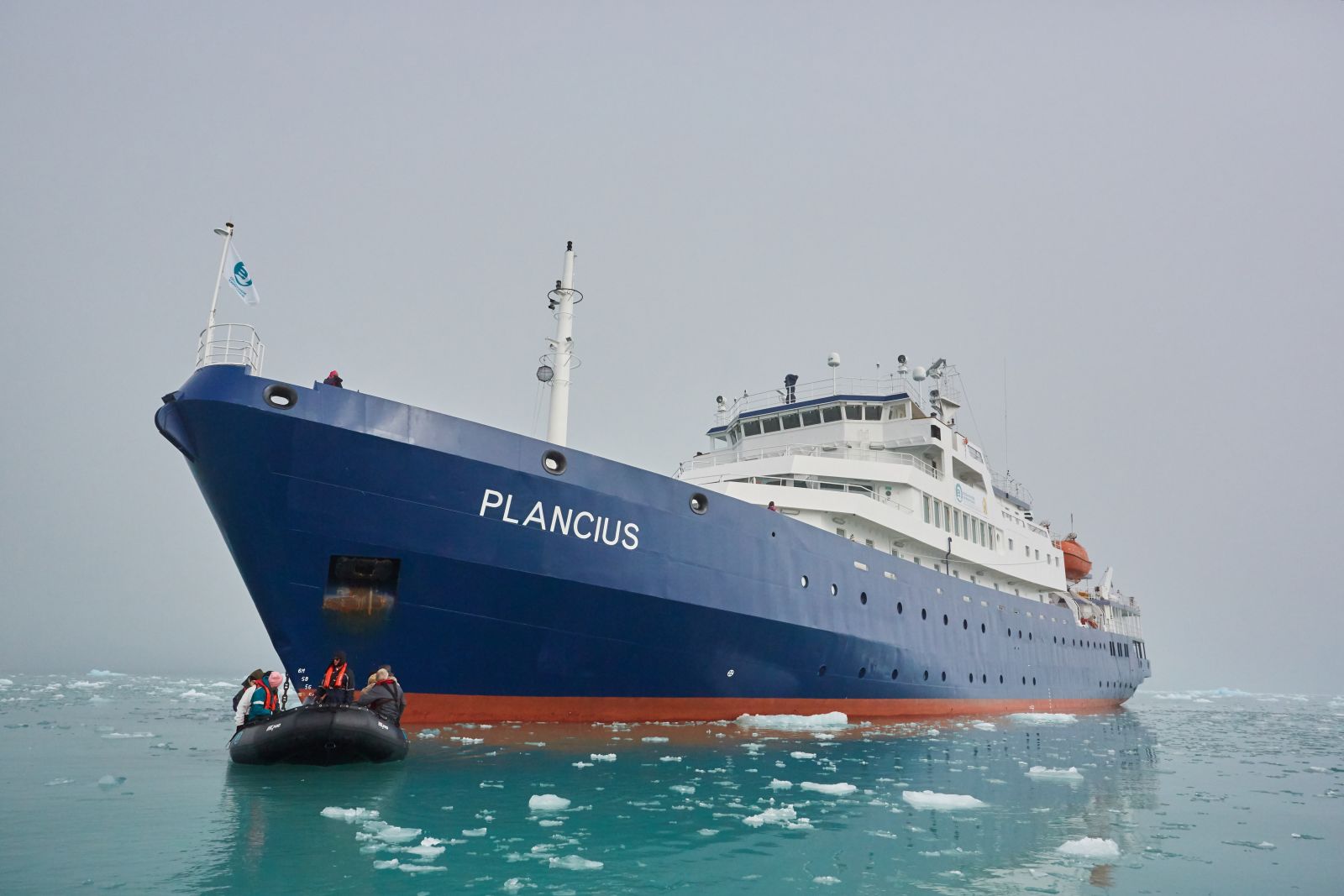
Plancius Liveaboard, Arctic Circle, Antarctica, Norway, Iceland, Argentina
Formerly a Polar Region navy ship was totally rebuilt in 2009 as passengers vessel. Large open deck giving excellent opportunities to enjoy the scenery. Comfortable boat with a hotel type accommodation, but not luxurious, it’ s made for explorers. Camping, kayaking, polar diving, a chance to see polar bears and northern lights.
Boat Interior
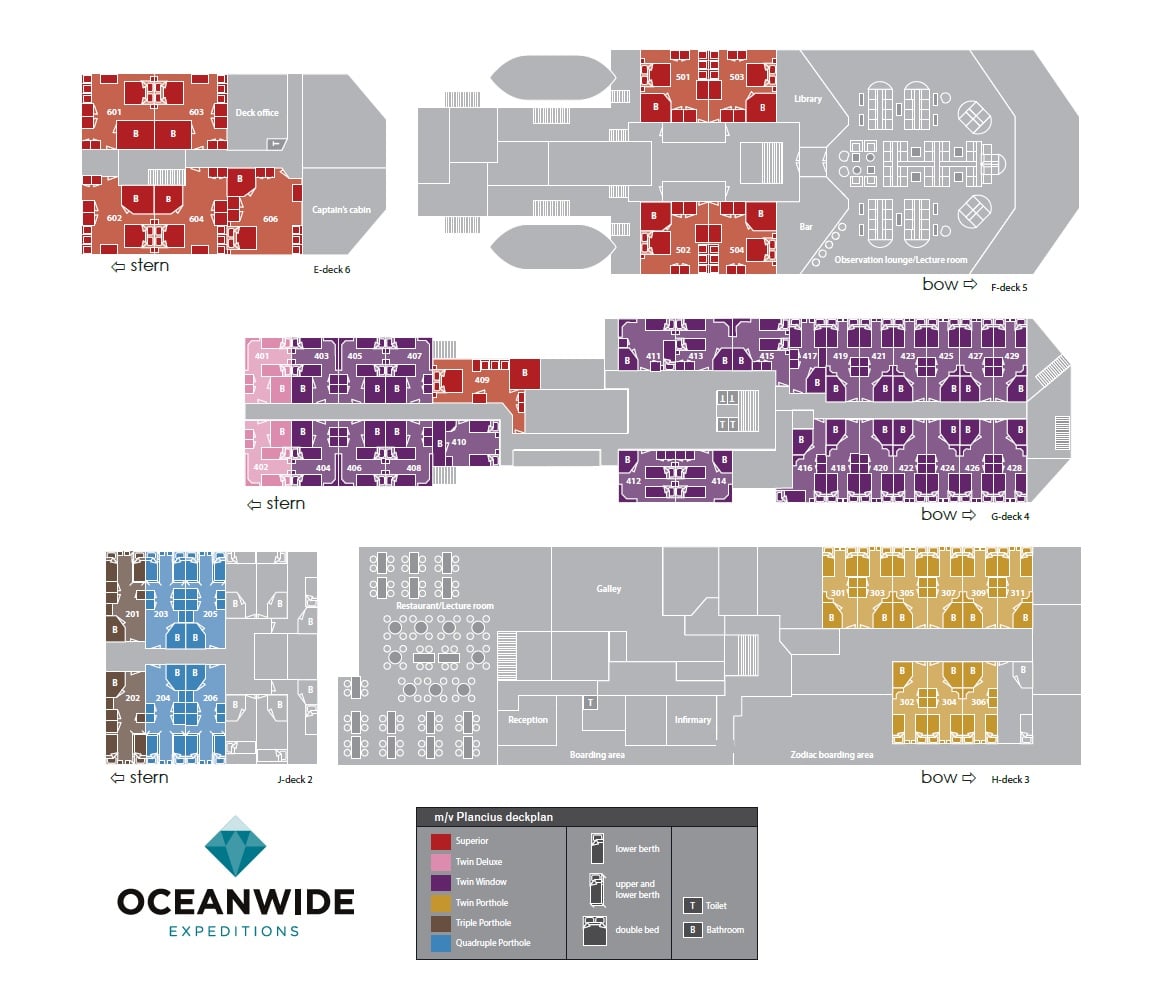
Plancus has 53 cabins on board that can accommodate 116 passengers. 4 stateroom has four bunk beds, 2 cabins suits for triple share. 35 cabins have twin beds, you can choose a cabin with a porthole or with the window to have a wider angle view.
Vessel’ s passengers can spend their time on the top deck observing the amazing view, trying to spot birds, whales or even polar bear that walk on the ice. There is also a spacious restaurant and an observation lounge with a bar and full panorama view.
Itinerary features
You can choose from a wide range of itineraries. Plancius gives an opportunity to explore Antarctic and Arctic, meet polar bears, observe Northern lights, meet penguins and lots of birds, visit old research stations. Noth Spitsbergen with glaciers and fjords will be on your way. Maybe you will choose Antarctica Basecamp trip that already includes camping, kayaking, snowshoe, mountaineering, photo workshops. Or visit the Falkland Islands to see largest breeding beaches for southern elephant seals. Don’ t miss a chance to see Aurora Borealis the magical northern lights. There is a special activity for divers polar diving. You will dive under shallow ice, down along walls, from the beach to see a variety of starfish species, different species of crabs, soft corals, anemones, jellyfish. Sea-hedgehogs. You might even have the opportunity to dive with Fur Seals, Leopard Seals or Penguins.
When to Go
The Antarctic Peninsula has a warmer and wetter climate; above freezing temperatures are common in the summer months. The average temperature for summer months ranges between -2C (28,4F) +5C (41F). For Norway the average temperature during the summer 10C (50 F). Svalbard is usually around -16 to -12 degrees Celsius (3 to 10 F) during the winter, and between 4 to 6C (39 to 43 F) in the summer
Cabins
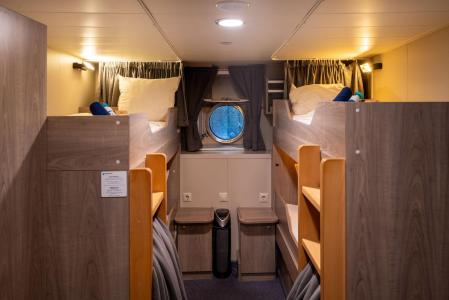
Quad Cabin
Quad Cabin
Quad Cabin
Deck:
Bedding:2 Twin Beds + 2 Twin Beds (Bunk-Style)
Max occupancy:4 Guests
Number of Cabins:4 Cabins
Ensuite Bathroom: Yes
Aircon: Yes
1 porthole, 2 upper & lower berths, private shower & toilet, desk & chair, flatscreen TV, telephone & WiFi (supplemented), hair dryer, ample storage space. This cabin is suitable for families traveling with children, or passengers who do not require a twin or more luxurious cabin
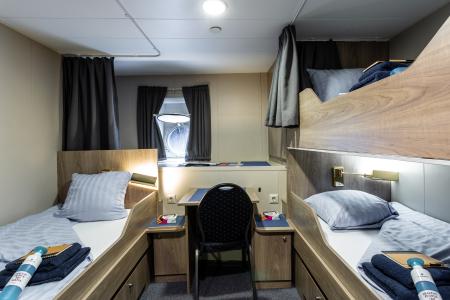
Triple Cabin
Triple Cabin
Triple Cabin
Deck:
Bedding:2 Twin Beds + 1 Twin Bed (Bunk-Style)
Max occupancy:3 Guests
Number of Cabins:2 Cabins
Ensuite Bathroom: Yes
Aircon: Yes
1 porthole, 1 upper berth & 2 lower berths, private shower & toilet, desk & chair, flatscreen TV, telephone & WiFi (supplemented), hair dryer, ample storage space. This cabin is suitable for families traveling with children, or passengers who do not require a twin or more luxurious cabin
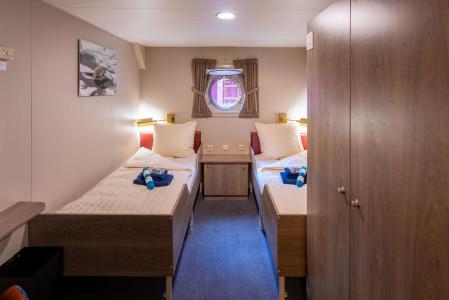
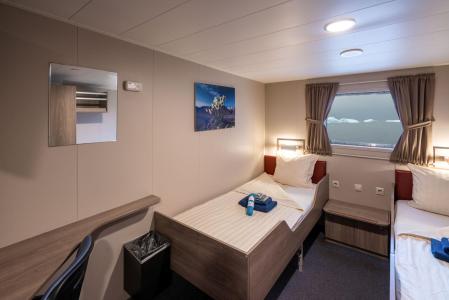
Twin Cabin with Porthole
Twin Cabin with Porthole
Twin Cabin with Porthole
Deck:
Bedding:Twin Beds
Max occupancy:2 Guests
Number of Cabins:9 Cabins
Ensuite Bathroom: Yes
Aircon: Yes
1 porthole, 2 lower berths, private shower & toilet, desk & chair, flatscreen TV, telephone & WiFi (supplemented), hair dryer, ample storage space
Twin Cabin with Window
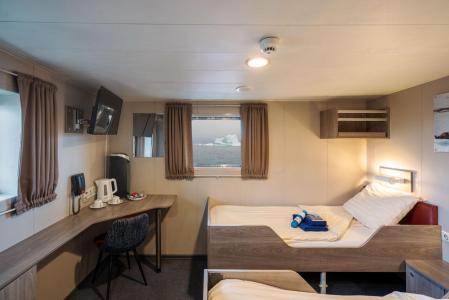
Twin Cabin with Window
Twin Cabin with Window
Deck:
Bedding:Twin Beds
Max occupancy:2 Guests
Number of Cabins:26 Cabins
Ensuite Bathroom: Yes
Aircon: Yes
1 window, 2 lower berths, private shower & toilet, desk & chair, flatscreen TV, telephone & WiFi (supplemented), hair dryer, ample storage space
Twin Deluxe
Twin Deluxe
Twin Deluxe
Deck:
Bedding:Twin Beds
Max occupancy:2 Guests
Number of Cabins:2 Cabins
Ensuite Bathroom: Yes
Aircon: Yes
2 windows, 2 lower berths, private shower & toilet, desk & chair, flatscreen TV, telephone & WiFi (supplemented), hair dryer, ample storage space. These cabins are corner cabins and are slightly more spacious than the normal twin porthole/window cabins
Superior
Superior
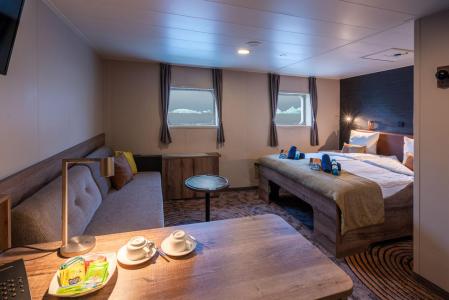
Superior
Deck:
Bedding:Double Bed
Max occupancy:2 Guests
Number of Cabins:10 Cabins
Ensuite Bathroom: Yes
Aircon: Yes
2 windows, 1 double bed, 1 sofa bed, private shower & toilet, desk & chair, flatscreen TV, telephone & WiFi (supplemented), refrigerator, coffee & tea maker, hairdryer, ample storage space
Boat Specification
Dive Facilities
- Tenders for Diving
Boat navigation & safety
Full safety
Food & Drinks
- Western Food
- Local Food
- Dietary Restrictions
- Buffet Style
- Alcoholic Beverages and Spirits
- Hot & Cold Soft Drinks
Onboard Facilities
- Onboard Kayaks
- Audio & Video Entertainment
- Air Conditioned Saloon
- Indoor Saloon
- Non-Diver (Snorkeler) Friendly
- Land Excursions
Plancius Reviews
Similar Liveaboards
Plancius Liveaboard Itineraries
Antarctica & the Polar Circle - Deep South Discovery Voyage (12 nights) (Ushuaia (Argentina)-Ushuaia (Argentina))
Included
- Voyage aboard the indicated vessel as indicated in the itinerary
- All meals throughout the voyage aboard the ship including snacks, coffee and tea
- All shore excursions and activities throughout the voyage by Zodiac
- Program of lectures by noted naturalists and leadership by experienced expedition staff
- Complimentary use of waterproof neoprene expedition muck boots and snowshoes
- Luggage transfer from pick-up point to the vessel on the day of embarkation, in Ushuaia
- Pre-scheduled group transfer from the vessel to the airport in Ushuaia (directly after disembarkation)
- All miscellaneous service taxes and port charges throughout the programme
- Comprehensive pre-departure material
- Complimentary Wi-Fi connectivity. All guests receive 1.5 GB of data usage per day, which resets every 24 hours
- Complimentary Dopper water bottle for use during and after your expedition
- Free short-term DAN diving insurance (upon request)
Extra cost
- International and domestic flights
- Visa
- Pre- and post- land arrangements
- Government arrival and departure taxes
- Meals ashore
- Baggage, cancellation and personal insurance (which is strongly recommended)
- Excess baggage charges and all items of a personal nature such as laundry, bar, beverage charges and telecommunication charges
- The customary gratuity at the end of the voyages for stewards and other service personnel aboard (guidelines will be provided)
- Crew gratuities
- Travel insurance
Program
Day 1: End of the world, start of a journey
Your voyage begins where the world drops off. Ushuaia, Argentina, reputed to be the southernmost city on the planet, is located on the far southern tip of South America. Starting in the afternoon, you embark from this small resort town on Tierra del Fuego, nicknamed “The End of the World,” and sail the mountain-fringed Beagle Channel for the remainder of the evening.
Day 2-3: Path of the polar explorers
Over the next two days on the Drake Passage, you enjoy some of the same experiences encountered by the great polar explorers who first charted these regions: cool salt breezes, rolling seas, maybe even a fin whale spouting up sea spray. After passing the Antarctic Convergence – Antarctica’s natural boundary, formed when north-flowing cold waters collide with warmer sub-Antarctic seas – you are in the circum-Antarctic upwelling zone. Not only does the marine life change, the avian life changes too. Wandering albatrosses, grey-headed albatrosses, black-browed albatrosses, light-mantled sooty albatrosses, cape pigeons, southern fulmars, Wilson’s storm petrels, blue petrels, and Antarctic petrels are a few of the birds you might see.
Day 4-10: Sights of late summer Antarctica
Options for Antarctic Peninsula activities are many, and no less great during the late summer. Humpback whales are prolific in this region, gorging themselves on krill before their migration north. The penguin chicks are also fledging, stirring up activity on the beaches while sleek leopard seals lie in wait, poised to attack the less fortunate ones.
Sites for your Antarctic adventures may include:
Livingston Island – Here you find a wide variety of gentoo and chinstrap penguins on Hannah Point, as well as southern giant petrels and elephant seals hauling out onto the beach.
Deception Island – Actually a subducted crater, this island opens into the sea and creates a natural harbor for the ship. An abandoned whaling station, and multiple bird species – cape petrels, kelp gulls, brown and south polar skuas, and Antarctic terns – can be seen here. Wilson’s storm petrels and black-bellied storm petrels also nest in the ruins of the whaling station in Whalers Bay.
Cuverville Island – A small precipitous island nestled between the mountains of the Antarctic Peninsula and Rongé Island, Cuverville houses a large colony of gentoo penguins and breeding pairs of brown skuas.
Neko Harbour – An epic landscape of mammoth glaciers and endless wind-carved snow, Neko Harbour offers opportunities for a Zodiac cruise and landing that afford the closest views of the surrounding alpine peaks. You might also be able to set foot on the continent here.
Paradise Bay – You could take a Zodiac cruise in these sprawling, ice-flecked waters, where you have a good chance of seeing humpback and minke whales.
Pléneau & Petermann Islands – If the ice allows it, you may sail through the Lemaire Channel in search of Adélie penguins and blue-eyed shags. There’s also a good chance you’ll encounter humpback and minke whales as well as leopard seals.
Crystal Sound – Your journey takes you south along the Argentine Islands to this ice-packed body of water, and from here across the Polar Circle in the morning.
Detaille Island – You may make a landing at an abandoned British research station here, taking in the island’s lofty mountains and imposing glaciers.
Fish Islands – Further north you encounter one of the southernmost Adélie penguin and blue-eyed shag colonies in the Antarctic Peninsula.
Melchior Islands – These islands offer a beautiful landscape rich with icebergs. Leopard seals, crabeater seals, and whales are found here, and there are excellent opportunities for diving.
Conditions on the Drake Passage determine the exact time of departure.
Day 11-12: Familiar seas, familiar friends
Your return voyage is far from lonely. While crossing the Drake, you’re again greeted by the vast array of seabirds remembered from the passage south. But they seem a little more familiar to you now, and you to them.
Day 13: There and back again
Every adventure, no matter how grand, must eventually come to an end. It’s now time to disembark in Ushuaia, but with memories that will accompany you wherever your next adventure lies.
Routes can be affected by adverse weather conditions and unforeseen events, force majeure or other similar reasons
Antarctica - Elephant Island, Weddell Sea, Polar Circle (14 nights) (Ushuaia (Argentina)-Ushuaia (Argentina))
Included
- Voyage aboard the indicated vessel as indicated in the itinerary
- All meals throughout the voyage aboard the ship including snacks, coffee and tea
- All shore excursions and activities throughout the voyage by Zodiac
- Program of lectures by noted naturalists and leadership by experienced expedition staff
- Complimentary use of waterproof neoprene expedition muck boots and snowshoes
- Luggage transfer from pick-up point to the vessel on the day of embarkation, in Ushuaia
- Pre-scheduled group transfer from the vessel to the airport in Ushuaia (directly after disembarkation)
- All miscellaneous service taxes and port charges throughout the programme
- Comprehensive pre-departure material
- Complimentary Wi-Fi connectivity. All guests receive 1.5 GB of data usage per day, which resets every 24 hours
- Complimentary Dopper water bottle for use during and after your expedition
- Free short-term DAN diving insurance (upon request)
Extra cost
- International and domestic flights
- Visa
- Pre- and post- land arrangements
- Government arrival and departure taxes
- Meals ashore
- Baggage, cancellation, and personal insurance (which is strongly recommended).
- Excess baggage charges and all items of a personal nature, such as laundry, bar, beverage charges, and telecommunication charges
- The customary gratuity at the end of the voyage for stewards and other service personnel aboard (guidelines will be provided)
- Crew gratuities
- Travel insurance
Program
Day 1: End of the world, start of a journey
Your voyage begins where the world drops off. Ushuaia, Argentina, reputed to be the southernmost city on the planet, is located on the far southern tip of South America. Starting in the afternoon, you embark from this small resort town on Tierra del Fuego, nicknamed “The End of the World,” and sail the mountain-fringed Beagle Channel for the remainder of the evening.
Day 2-3: Path of the polar explorers
Over the next two days on the Drake Passage, you enjoy some of the same experiences encountered by the great polar explorers who first charted these regions: cool salt breezes, rolling seas, maybe even a fin whale spouting up sea spray. After passing the Antarctic Convergence – Antarctica’s natural boundary, formed when north-flowing cold waters collide with warmer sub-Antarctic seas – you are in the circum-Antarctic upwelling zone.
Not only does the marine life change, the avian life changes too. Wandering albatrosses, grey-headed albatrosses, black-browed albatrosses, light-mantled sooty albatrosses, cape pigeons, southern fulmars, Wilson’s storm petrels, blue petrels, and Antarctic petrels are a few of the birds you might see.
Day 4: From Point Wild to the Weddell Sea
We will arrive early to the famous Point Wild, Elephant Island, where Shackleton’s crew made their first landing after the loss of their ship, Endurance. This inhospitable spit of land is a favorite among our guests, and if conditions permit, we will offer activities around the point before setting off for the Weddell Sea.
Day 5: Weddell Sea Devil Island
Today you enter the wondrous Weddell Sea, a relatively unvisited area in which we hope to carry out activities in Erebus and Terror Gulf. We may also visit such places such as Beak Island and Devil Island, which boast some stunning scenery as well as the pack ice for which the Weddell Sea is famous.
Day 6: Exploring the most remote regions
As we continue to explore the area of Erebus and Terror Gulf, we look for new opportunities for activities. You may also visit Vega Island, experiencing the wilderness of Antarctica in its most remote places.
Day 7: Orléans Strait whale search
Now we sail down the western side of the Antarctic Peninsula, entering the Orleans Strait. Here we hope to see humpback and orca whales as we sail toward Mikklesen Harbor for our afternoon activities.
Day 8: Port monuments and island wildlife
Passing the Lemaire Channel, you next arrive in the area of Port Charcot, where there is a cairn that was erected by the French Antarctic Expedition of 1903 – 05. In the afternoon, we head to Petermann Island to see a great variety of birdlife. You might also enjoy Zodiac cruises among icebergs that are highly popular with leopard seals and crabeater seals. Minke whales, humpbacks, and gentoo penguins can also be found here.
Day 9-10: Detaille Island’s historic station
Today we reach Crystal Sound, viewing the area’s beautiful ice formations and wildlife before landing at Detaille Island. This remote island was once home to a British research station that is now an historic monument.
Day 11: Amazing Argentine islands
Next you arrive at the Yalour Islands, a small archipelago composed mostly of isolated rocks and one principal island that offers us a rewarding landing. Home to Adélie penguins and some of the most southerly gentoos in the world, Yalour also has small patches of bearded and crustose lichen, including xanthoria, buellia, caloplaca, and usnea. Extensive moss beds and some Antarctic hair grass (Deschampsia antarctica) can be seen as well.
Day 12: Farewell to Antarctica
We have our farewell to Antarctica in the Melchior Islands for our final activities before heading towards the Drake Passage.
Day 13-14: Familiar seas, familiar friends
Your return voyage is far from lonely. While crossing the Drake, you’re again greeted by the vast array of seabirds remembered from the passage south. But they seem a little more familiar to you now, and you to them.
Day 15: There and back again
Every adventure, no matter how great, must eventually come to an end. It’s now time to disembark in Ushuaia, but with memories that will accompany you wherever your next journey leads.
Routes can be affected by adverse weather conditions and unforeseen events, force majeure or other similar reasons
- Arrival at Ushuaia Airport.
- The voyage starting in the afternoon, you embark from this small resort town on Tierra del Fuego.
- Boat's representatives will arrange a transfer to the boat
- After the disembarkation, boat's representatives will arrange a transfer to the airport
Weddell Sea - Antarctic Discoverer (11 nights) (Ushuaia (Argentina)-Ushuaia (Argentina))
Included
- 11 nights accommodation
- Full board
- Snacks, coffee and tea
- All shore excursions and activities throughout the voyage by zodiac
- Program of lectures by noted naturalists and leadership by experienced expedition staff
- Free use of rubber boots and snowshoes
- Luggage transfer from the pick-up point to the vessel on the day of embarkation, in Ushuaia
- Scheduled group transfer from the vessel to the airport in Ushuaia (directly after disembarkation)
- All miscellaneous service taxes and port charges throughout the programme
- Comprehensive pre-departure material
- Free short-term DAN diving insurance (upon request)
Extra cost
- International and domestic flights
- Visa
- Transfers except for listed in the inclusions
- Pre- and post- land arrangements
- Polar diving
- Meals ashore
- Government arrival and departure taxes
- Baggage, cancellation and personal insurance (which is mandatory)
- Excess baggage charges and all items of a personal nature such as laundry, bar, beverage charges and telecommunication charges
- Crew gratuities
- Travel insurance
Program
Day 1:
Onboarding in the small resort town on Tierra del Fuego – nicknamed “The End of the World”, meeting the crew & briefing.
Day 2 & 3:
Path of the Polar Explorers.
Over the next two days on the Drake Passage, you catch a taste of life from the perspective of the polar explorers who first braved these regions: cool salt breezes, rolling seas, maybe even a fin whale blasting up sea spray. After passing the Antarctic Convergence – Antarctica’s natural boundary formed when north-flowing cold waters collide with warmer subantarctic seas – you are in the circum-Antarctic up welling zone. Not only does the marine life change, but the avian life also changes too: A variety of albatrosses and petrels show up, along with Cape pigeons and southern fulmars. Then, near the South Shetlands Islands, the first icebergs flash into sight.
Day 4-8:
Enter the Antarctic.
You sail directly into the Weddell Sea through the often ice-clogged Antarctic Sound. Huge tabular icebergs herald your arrival to the eastern side of the Antarctic Peninsula. The Weddell Sea is largely covered in sea ice during the year, but the northwestern corner offers great opportunities for exploration in places only the lucky few get to visit. The sites for your activities may include: Paulet Island – A huge number of Adélie penguins take residence here. Brown Bluff – Maybe the most scenic location in the entire northern tip of the Antarctic Continent: sheer canyon walls, fallen boulders, beautiful volcanic creations capped with ice. A large Adélie penguin rookery lives here, with gentoo penguins and nesting snow petrels also to be found. Dundee Island – A mostly uninhabited Argentine station, Base Petrel, can be seen here, as well as Antarctic fur seals (and southern elephant seals) along the coastline. Farther into the Weddell Sea, the options vary with the ice conditions: James Clark Ross Island – You can explore a number of rarely visited places here. The imagination is further stirred by suggestive names like Brandy Bay and Whiskey Bay. Devil Island – A large Adélie penguin rookery, as well as stunning views of Erebus and Terror Gulf, are seen here. Snow Hill Island – This location, known for its sedimentary rock, tells tales of the incredible Antarctic explorations of the early 20th century.
Day 9:
Scenes of South Shetland.
The volcanic islands of the South Shetlands are windswept and often cloaked in mist, but they do offer subtle pleasures: There’s a wide variety of flora (mosses, lichens, flowering grasses) and no small amount of fauna (gentoo penguins, chinstrap penguins, southern giant petrels). In Deception Island, the ship plunges through Neptune’s Bellows and into the flooded caldera. Here you find hot springs, an abandoned whaling station, and thousands of cape petrels – along with a number of kelp gulls, brown and south polar skuas, and Antarctic terns. Wilson’s storm petrels and black-bellied storm petrels also nest in the ruins of the whaling station in Whalers Bay. As an alternative, you may be able to engage in activities near Half Moon Island. Here chinstrap penguins and Weddell seals often haul out onto the beach near Cámara Base, an Argentine scientific research station. Conditions on the Drake Passage determine the exact time of departure.
Day 10-11:
Familiar Seas, Familiar Friends.
Your return voyage is far from lonely. While crossing the Drake, you’re again greeted by the vast array of seabirds remembered from the passage south. But they seem a little more familiar to you now, and you to them.
Day 12:
Check-out from the yacht.
Routes can be affected by adverse weather conditions and unforeseen events, force majeure or other similar reasons (You may find a detailed map by the link)