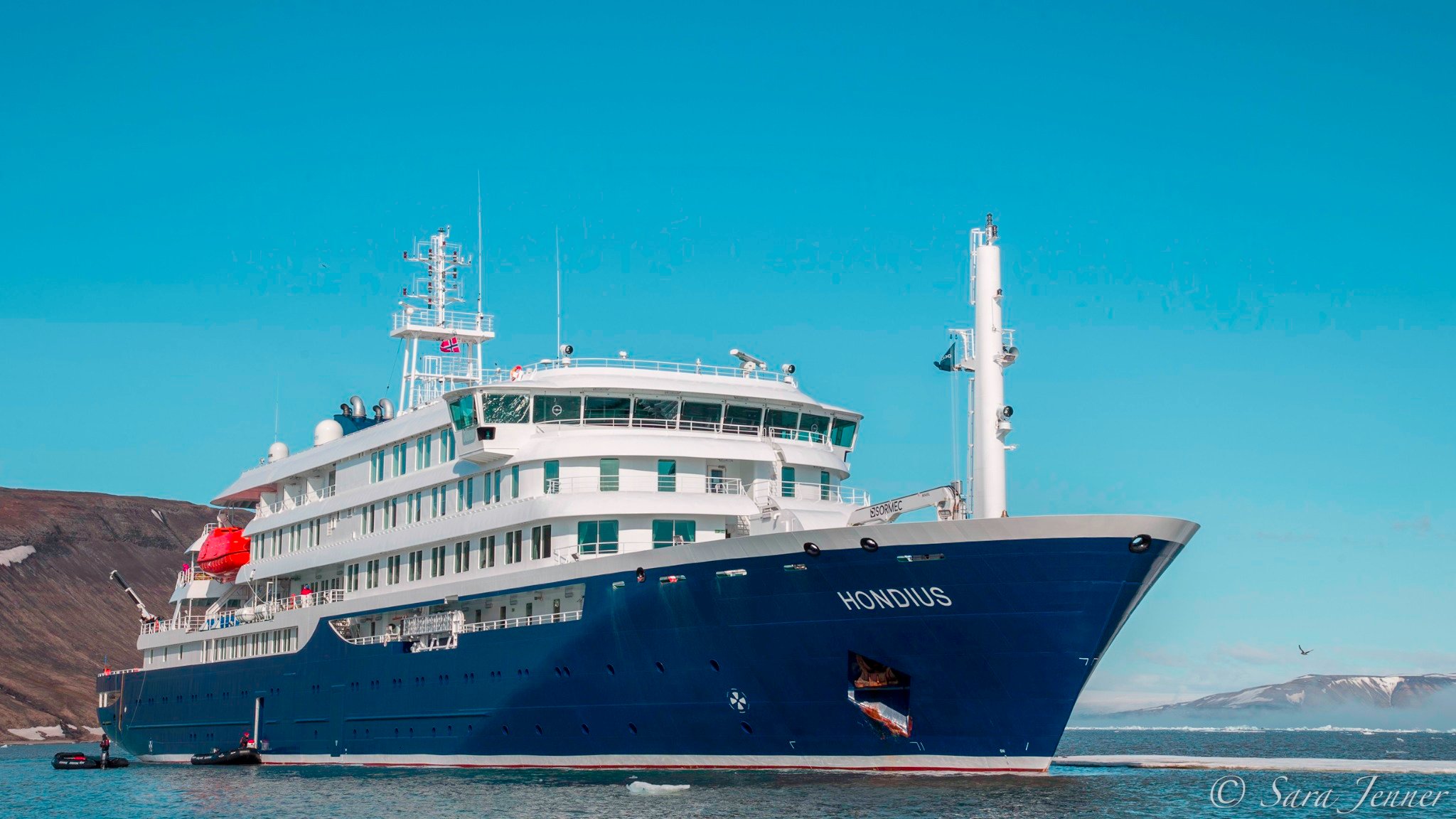
Hondius Liveaboard, Arctic Circle, Iceland, Argentina
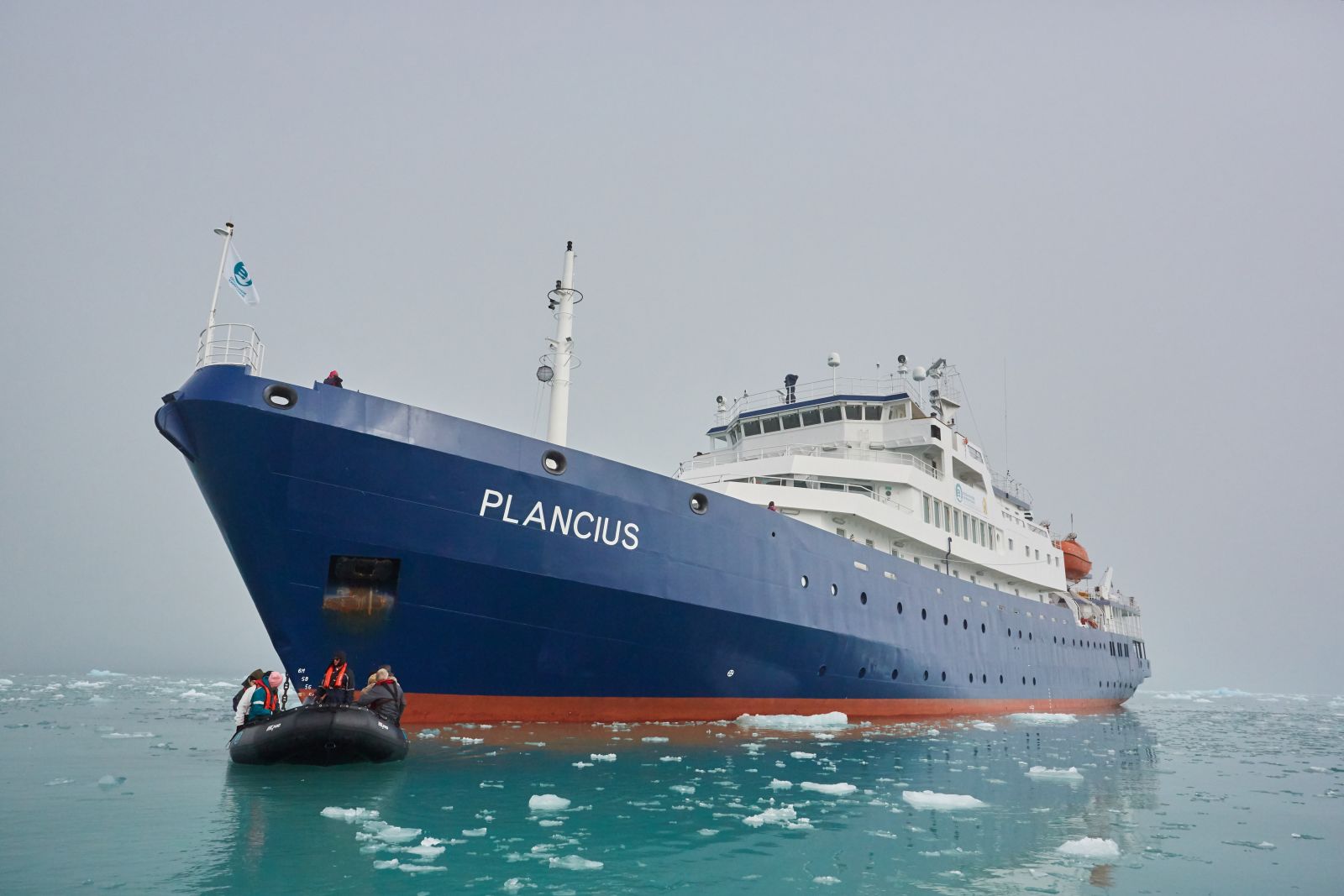
The boat meets the latest and the highest standard of Lloyd Register to sail in Polar Region. Hondius offers hotel type accommodation. Fast zodiacs to a short time in the sea and focus on shore activities. A wide variety of activities including polar diving, kayaking, camping, photo workshops.
Boat Interior
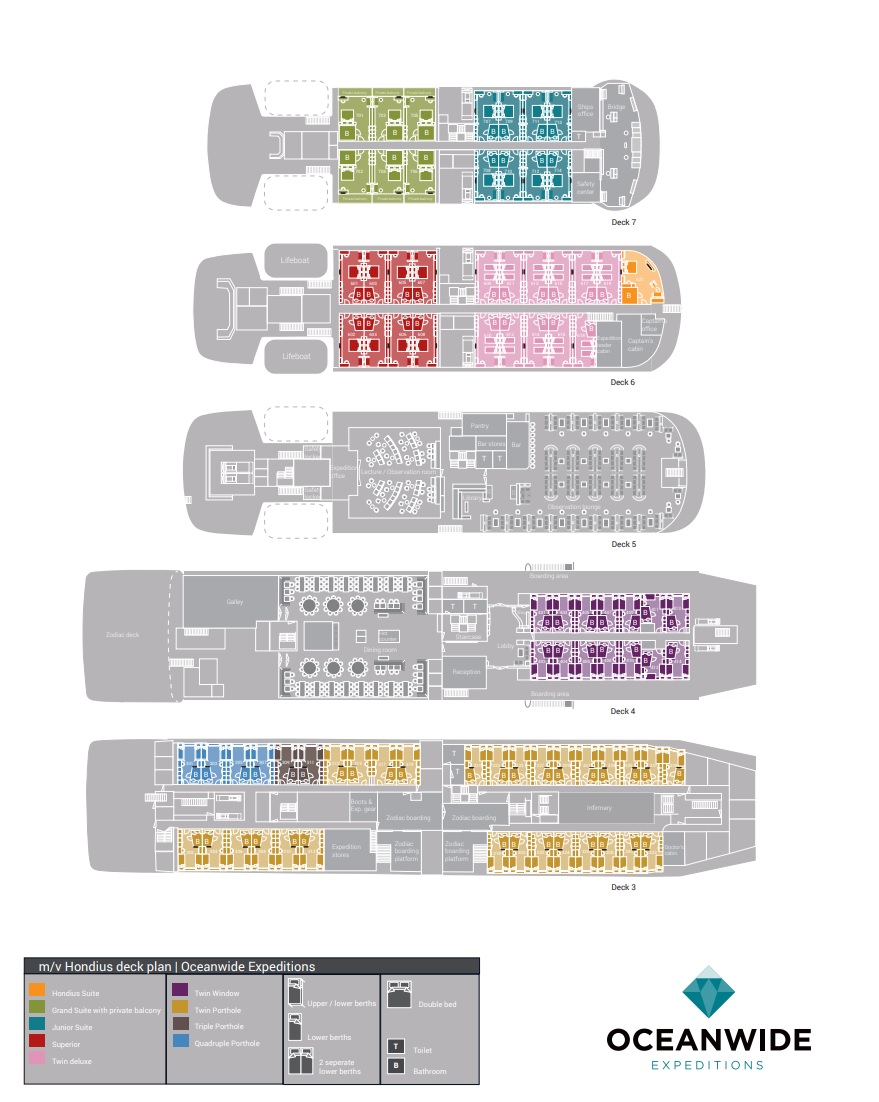
Hondius can carry 176 passengers on board. The boat has 82 cabins in total. 4 quad cabins, 2 trips can be shared if you are traveling with friends or with your family. There are also 28 twin rooms with portholes and 14 twin rooms with windows. For those who prefer luxury accommodation, boats offers to stay at one of the suits or book the special hondius suit that has 4 windows to enjoy the beautiful view, a double bed, and comfortable sofa. All staterooms have private facilities, TV, coffee tea maker, hairdryer, cabinet.
A big lecture room is perfect for workshops, exhibitions, and performances. Boat’ s guest can also spend time in the large observation lounge.
Itinerary features
Hondius offers various routes. Visit the Falkland Islands to see albatross colonies, Magellanic penguins and gentoos or elephant seals. Take a part in Antarctica Discovery and learning cruise, where you can to listen to naturalists lectures. You may get a chance to visit the former British research station now a museum and post office. Hondius passengers will get a unique chance to meet whales and to see one of the most amazing sightsing northern lights.
When to Go
The Antarctic Peninsula has a warmer and wetter climate; above freezing temperatures are common in the summer months. The average temperature for summer months ranges between -2C (28,4F) +5C (41F). For Norway the average temperature during the summer 10C (50 F). Svalbard is usually around -16 to -12 degrees Celsius (3 to 10 F) during the winter, and between 4 to 6C (39 to 43 F) in the summer
Cabins
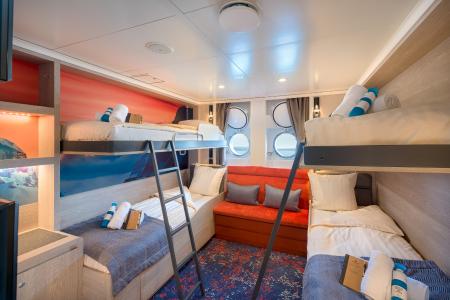
Quad Cabin
Quad Cabin
Quad Cabin
Deck:
Bedding:2 Twin Beds + 2 Twin Beds (Bunk-Style)
Max occupancy:4 Guests
Number of Cabins:4 Cabins
Ensuite Bathroom: Yes
Aircon: Yes
2 portholes, 2 upper & lower berths, small sofa, private shower & toilet, flatscreen TV, desk & chair, telephone and WiFi (supplemented), coffee & tea maker, hairdryer, cabinet, wardrobe, safe. This cabin is suitable for families traveling with children, or passengers who do not require a twin or more luxurious cabin
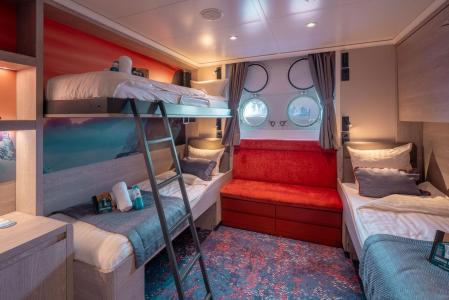
Triple Cabin
Triple Cabin
Triple Cabin
Deck:
Bedding:2 Twin Beds + 1 Twin Bed (Bunk-Style)
Max occupancy:3 Guests
Number of Cabins:2 Cabins
Ensuite Bathroom: Yes
Aircon: Yes
2 portholes,1 upper berth & 2 lower berths, small sofa, private shower & toilet, flatscreen TV, desk & chair, telephone and WiFi (supplemented), coffee & tea maker, hairdryer, cabinet, wardrobe, safe. This cabin is suitable for families traveling with children, or passengers who do not require a twin or more luxurious cabin
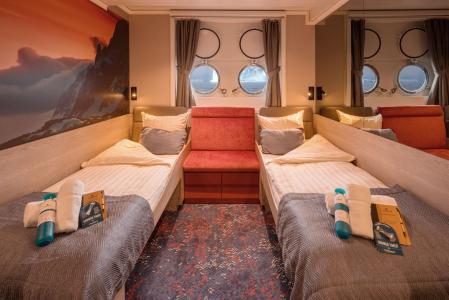
Twin Cabin with Porthole
Twin Cabin with Porthole
Twin Cabin with Porthole
Deck:
Bedding:Twin Beds
Max occupancy:2 Guests
Number of Cabins:28 Cabins
Ensuite Bathroom: Yes
Aircon: Yes
2 portholes, 2 single beds, small sofa, private shower & toilet, flatscreen TV, desk & chair, telephone and WiFi (supplemented), coffee & tea maker, hairdryer, cabinet, wardrobe safe
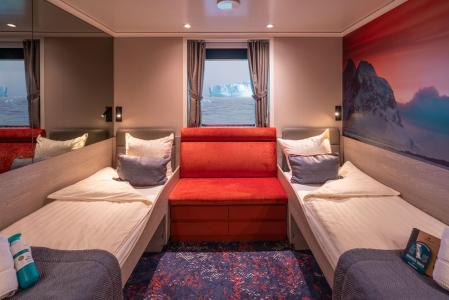
Twin Cabin with Window
Twin Cabin with Window
Twin Cabin with Window
Size:13 m2
Deck:
Bedding:Twin Beds
Max occupancy:2 Guests
Number of Cabins:14 Cabins
Ensuite Bathroom: Yes
Aircon: Yes
1 window, 2 single beds, small sofa, private shower & toilet, flatscreen TV, desk & chair, telephone and WiFi (supplemented), coffee & tea maker, hair dryer, cabinet, wardrobe, safe
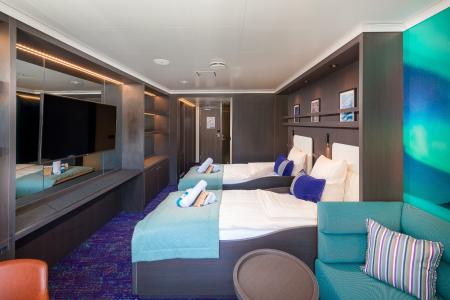
Twin Deluxe
Twin Deluxe
Twin Deluxe
Size:20 m2
Deck:
Bedding:Twin Beds
Max occupancy:2 Guests
Number of Cabins:11 Cabins
Ensuite Bathroom: Yes
Aircon: Yes
2 windows, 2 single beds, sofa, private shower & toilet, flatscreen TV, desk & chair, telephone and WiFi (supplemented), refrigerator, coffee & tea maker, hairdryer, cabinet, wardrobe, safe
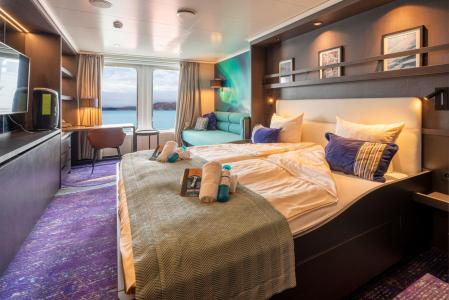
Superior
Superior
Superior
Size:21 m2
Deck:
Bedding:Double Bed
Max occupancy:2 Guests
Number of Cabins:8 Cabins
Ensuite Bathroom: Yes
Aircon: Yes
2 windows,1 double bed, sofa, private shower & toilet, flatscreen TV, desk & chair, telephone and WiFi (supplemented), refrigerator, coffee & tea maker, hairdryer, cabinet, wardrobe, safe
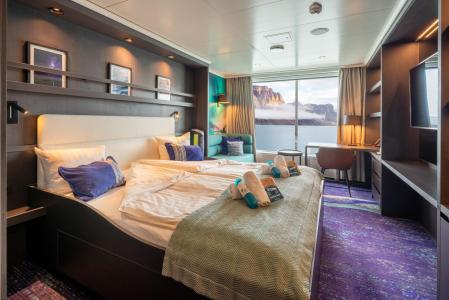
Junior Suite
Junior Suite
Junior Suite
Size:20 m2
Deck:
Bedding:Double Bed
Max occupancy:2 Guests
Number of Cabins:8 Cabins
Ensuite Bathroom: Yes
Aircon: Yes
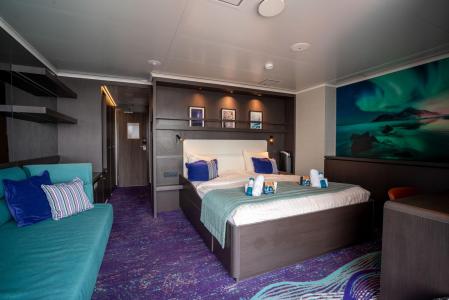
1 double window, 1 double bed, private shower & toilet, flatscreen TV, desk & chair, telephone and WiFi (supplemented), refrigerator, coffee & tea maker, hairdryer, cabinet, wardrobe, safe
Grand Suite with Private Balcony
Grand Suite with Private Balcony
Grand Suite with Private Balcony
Size:27 m2
Deck:
Bedding:Double Bed
Max occupancy:2 Guests
Number of Cabins:6 Cabins
Ensuite Bathroom: Yes
Aircon: Yes
1 double window, 1 double bed, sofa, private balcony, private shower & toilet, flatscreen TV, desk & chair, telephone and WiFi (supplemented), refrigerator, coffee & tea maker, hairdryer, cabinet, wardrobe, safe
Boat Specification
Dive Facilities
- Compressors
- Tenders for Diving
- DIN Adaptors
Boat navigation & safety
Full safety
Food & Drinks
- Western Food
- Dietary Restrictions
- Buffet Style
- Alcoholic Beverages and Spirits
- Hot & Cold Soft Drinks
- Snacks All Day
Onboard Facilities
- Audio & Video Entertainment
- Indoor Saloon
- Bar
- Non-Diver (Snorkeler) Friendly
- Land Excursions
Similar Liveaboards
Hondius Liveaboard Itineraries
Antarctica - Whale Watching Discovery And Learning Voyage (10 nights) (Ushuaia (Argentina)-Ushuaia (Argentina))
Included
- 10 nights accommodation
- Full board
- Snacks, coffee, and tea
- Shore excursions and activities throughout the voyage by Zodiac
- Program of lectures by noted naturalists and leadership by experienced expedition staff
- Free use of rubber boots and snowshoes
- Luggage transfer from pick-up point to the vessel on the day of embarkation, in Ushuaia
- Scheduled group transfer from the vessel to the airport in Ushuaia (directly after disembarkation)
- All miscellaneous service taxes and port charges throughout the program
- Comprehensive pre-departure material
- Free short-term DAN diving insurance (upon request)
Extra cost
- International and domestic flights
- Visa
- Pre- and post- land arrangements
- Transfers to/from the vessel outside Spitsbergen
- Meals ashore
- Government arrival and departure taxes
- Baggage, cancellation and personal insurance (which is mandatory)
- Excess baggage charges and all items of a personal nature such as laundry, bar, beverage charges and telecommunication charges
- Crew gratuities
- Travel insurance
Program
Day 1:
Starting in the afternoon, you embark from this small resort town on Tierra del Fuego, nicknamed “The End of the World,” and sail the mountain-fringed Beagle Channel for the remainder of the evening.
Day 2-3:
Over the next two days on the Drake Passage, you enjoy some of the same experiences encountered by the great polar explorers who first charted these regions: cool salt breezes, rolling seas, maybe even a fin whale spouting up sea spray. After passing the Antarctic Convergence - Antarctica’s natural boundary, formed when north-flowing cold waters collide with warmer sub-Antarctic seas - you are in the circum-Antarctic upwelling zone. Not only does the marine life change, the avian life changes too. Wandering albatrosses, grey-headed albatrosses, black-browed albatrosses, light-mantled sooty albatrosses, cape pigeons, southern fulmars, Wilson’s storm petrels, blue petrels, and Antarctic petrels are a few of the birds you might see.
Day 4-8:
Gray stone peaks sketched with snow, towers of broken blue-white ice, and dramatically different wildlife below and above. You first pass the snow-capped Melchior Islands and Schollaert Channel, sailing between Brabant and Anvers Islands.
Sites you may visit include:
Danco Island - Activities here may focus on the gentoo penguins nesting on the island, in addition to the Weddell and crabeater seals that can be found nearby.
Neko Harbour - An epic landscape of mammoth glaciers and endless wind-carved snow, Neko Harbour offers opportunities for a Zodiac cruise and landing that afford the closest views of the surrounding alpine peaks.
Paradise Bay - You may be able to take a Zodiac cruise in these sprawling, ice-flecked waters, where there’s a good chance you’ll encounter humpback and minke whales.
Pléneau & Petermann Islands - If the ice allows it, you could sail through the Lemaire Channel in search of humpback and minke whales, as well as leopard seals.
Port Lockroy - After sailing through the Neumayer Channel, you may get a chance to visit the former British research station - now a museum and post office – of Port Lockroy on Goudier Island. You may also be able to partake in activities around Jougla Point, meeting gentoo penguins and blue-eyed shags.
At the nearby sites, such as Damoy Point there may be the opportunity for snowshoeing to the old ski-way, this is also one of our favourite camping sites.
Wilhelmina Bay & Guvernøren - This is a great place to spot humpback whales. You also may embark on a Zodiac cruise ending at the ghostly wreck of the Guvernøren, a whaling vessel that caught fire here in 1915. Around the Melchior Islands, amid a frozen landscape peopled with icebergs, you may encounter even more whales, leopard seals, and crabeater seals.
Charlotte Bay - We might encounter a variety of wildlife, including gentoo penguins, Weddell seals and possibly some migrating whale species such as humpback whales or minke whales.
Conditions on the Drake Passage determine the exact time of departure.
Day 9-10:
Your return voyage is far from lonely. While crossing the Drake, you’re again greeted by the vast array of seabirds remembered from the passage south. But they seem a little more familiar to you now, and you to them.
Day 11:
Check out from the yacht.
Routes can be affected by adverse weather conditions and unforeseen events, force majeure or other similar reasons (You may find a detailed map by the link)
- Arrival at Ushuaia International Airport, Argentina.
- Starting in the afternoon, you embark from this small resort town on Tierra del Fuego, nicknamed “The End of the World”
- Disembark in Ushuaia
Antarctica - Discovery and Learning Voyage (10 nights) (Ushuaia (Argentina)-Ushuaia (Argentina))
Included
- 10 nights accommodation
- Full board
- Snacks, coffee and tea
- Shore excursions and activities throughout the voyage by Zodiac
- Program of lectures by noted naturalists and leadership by experienced expedition staff
- Free use of rubber boots and snowshoes
- Luggage transfer from pick-up point to the vessel on the day of embarkation, in Ushuaia
- Scheduled group transfer from the vessel to the airport in Ushuaia (directly after disembarkation)
- All miscellaneous service taxes and port charges throughout the programme
- Comprehensive pre-departure material
- Free short-term DAN diving insurance (upon request)
Extra cost
- International and domestic flights
- Visa
- Pre- and post- land arrangements
- Transfers not stated in inclusions
- Meals ashore
- Government arrival and departure taxes
- Baggage, cancellation and personal insurance
- Excess baggage charges and all items of a personal nature such as laundry, bar, beverage charges and telecommunication charges
- Crew gratuities
- Travel insurance
Program
Day 1:
Onboarding, meeting the crew & briefing.
Day 2-3:
Over the next two days on the Drake Passage, you enjoy some of the same experiences encountered by the great polar explorers who first charted these regions: cool salt breezes, rolling seas, maybe even a fin whale spouting up sea spray. After passing the Antarctic Convergence – Antarctica’s natural boundary, formed when north-flowing cold waters collide with warmer sub-Antarctic seas – you are in the circum-Antarctic upwelling zone. Not only does the marine life change, the avian life changes too. Wandering albatrosses, grey-headed albatrosses, black-browed albatrosses, light-mantled sooty albatrosses, cape pigeons, southern fulmars, Wilson’s storm petrels, blue petrels, and Antarctic petrels are a few of the birds you might see.
Day 4-7:
Enter the Antarctic.
Gray stone peaks sketched with snow, towers of broken blue-white ice, and dramatically different wildlife below and above. You first pass the snow-capped Melchior Islands and Schollaert Channel, sailing between Brabant and Anvers Islands.
Sites you may visit include:
Danco Island – Activities here may focus on the gentoo penguins nesting on the island, in addition to the Weddell and crabeater seals that can be found nearby.
Neko Harbour – An epic landscape of mammoth glaciers and endless wind-carved snow, Neko Harbour offers opportunities for a Zodiac cruise and landing that afford the closest views of the surrounding alpine peaks.
Paradise Bay – You may be able to take a Zodiac cruise in these sprawling, ice-flecked waters, where there’s a good chance you’ll encounter humpback and minke whales.
Port Lockroy – After sailing through the Neumayer Channel, you may get a chance to visit the former British research station – now a museum and post office – of Port Lockroy on Goudier Island. You may also be able to partake in activities around Jougla Point, meeting gentoo penguins and blue-eyed shags. There are great opportunities also for kayaking and camping here, and when conditions are right, you can even snowshoe around the shore.
Day 8:
Scenes of South Shetland.
The volcanic islands of the South Shetlands are windswept and often cloaked in mist, but they do offer subtle pleasures: There’s a wide variety of flora (mosses, lichens, flowering grasses) and no small amount of fauna (gentoo penguins, chinstrap penguins, southern giant petrels). In Deception Island, the ship plunges through Neptune’s Bellows and into the flooded caldera. Here you find hot springs, an abandoned whaling station, and thousands of cape petrels – along with kelp gulls, brown and south polar skuas, and Antarctic terns. A good hike is a possibility in this fascinating and desolate volcanic landscape.
As an alternative, you may be able to engage in activities near Half Moon Island. Here chinstrap penguins and Weddell seals often haul out onto the beach near Cámara Base, an Argentine scientific research station. Conditions on the Drake Passage determine the exact time of departure.
Day 9-10:
Familiar seas, familiar friends.
Your return voyage is far from lonely. While crossing the Drake, you’re again greeted by the vast array of seabirds remembered from the passage south. But they seem a little more familiar to you now, and you to them.
Day 11:
Check-out from the yacht, group transfer to the airport.
Routes can be affected by adverse weather conditions and unforeseen events, force majeure or other similar reasons (You may find the detailed map by the link)
Falkland Islands - South Georgia - Elephant Island - Antarctica - Polar Circle (22 nights) (Ushuaia (Argentina)-Ushuaia (Argentina))
Included
- 22 nights accommodation
- Full board
- Snacks, coffee and tea
- Shore excursions and activities throughout the voyage by Zodiac
- Program of lectures by noted naturalists and leadership by experienced expedition staff
- Free use of rubber boots and snowshoes
- Luggage transfer from pick-up point to the vessel on the day of embarkation, in Ushuaia
- Scheduled group transfer from the vessel to the airport in Ushuaia (directly after disembarkation)
- All miscellaneous service taxes and port charges throughout the programme
- Comprehensive pre-departure material
- Free short-term DAN diving insurance (upon request)
Extra cost
- International and domestic flights
- Visa
- Pre- and post- land arrangements
- Transfers not stated in inclusions
- Meals ashore
- Government arrival and departure taxes
- Baggage, cancellation and personal insurance
- Excess baggage charges and all items of a personal nature such as laundry, bar, beverage charges and telecommunication charges
- Crew gratuities
- Travel insurance
Program
Day 1:
Onboarding, meeting the crew & briefing.
Day 2:
The winged life of the westerlies.
Several species of albatross follow the vessel into the westerlies, along with storm petrels, shearwaters, and diving petrels.
Day 3:
Finding the Falklands.
The Falkland (Malvinas) Islands offer an abundance of wildlife that is easily approachable, though caution is always advised. These islands are largely unknown gems, the site of a 1982 war between the UK and Argentina. Not only do various species of bird live here, but chances are great you’ll see both Peale’s dolphins and Commerson’s dolphins in the surrounding waters.
During this segment of the voyage, you may visit the following sites:
West Point Island - This beautiful island hosts a bounty of birdlife, from shorebirds near the landing site to black-browed albatrosses on the nest. Among them is a rookery of rockhopper penguins who have to undertake an incredible climb from the sea to get to their nests among the albatrosses.
Saunders Island - On Saunders Island, you can see the black-browed albatross and its sometimes-clumsy landings, along with breeding imperial shags and rockhopper penguins. King penguins, Magellanic penguins, and gentoos are also found here.
Day 4:
The seat of Falklands culture.
The capital of the Falklands and center of its culture, Port Stanley has some Victorian-era charm: colorful houses, well-tended gardens, and English-style pubs are all to be found here. You can also see several century-old clipper ships nearby, silent witnesses to the hardships of 19th-century sailors. The small but interesting museum is also worth a visit, covering the early days of settlement up to the Falklands War. Approximately 2,100 people live in Port Stanley. Feel free to wander at will, though be aware that admission fees to local attractions are not included in the voyage.
Day 5-6:
Once more to the sea.
En route to South Georgia, you now cross the Antarctic Convergence. The temperature cools considerably within the space of a few hours, and nutritious water rises to the surface of the sea due to colliding water columns. This phenomenon attracts a multitude of seabirds near the ship, including several species of albatross, shearwaters, petrels, prions, and skuas.
Day 7-10:
South Georgia journey.
Today you arrive at the first South Georgia activity site. Please keep in mind that weather conditions in this area can be challenging, largely dictating the program.
Over the next several days, you have a chance to visit the following sites:
Prion Island - This location is closed during the early part of the wandering albatross breeding season (November 20 - January 7). From January on, the breeding adults have found their partners and are sitting on eggs or nursing their chicks. Enjoy witnessing the gentle nature of these animals, which possess the largest wingspan of any birds in the world.
Fortuna Bay - Near beaches inhabited by various penguins and seals, you have the chance to follow the final leg of Shackleton’s route to the abandoned whaling village of Stromness. This path cuts across the mountain pass beyond Shackleton’s Waterfall, and as the terrain is partly swampy, be prepared to cross a few small streams.
Salisbury Plain, St. Andrews Bay, Gold Harbour - These sites not only house the three largest king penguin colonies in South Georgia, they’re also three of the world’s largest breeding beaches for southern elephant seals. Only during this time of year do they peak in their breeding cycle. Watch the four-ton bulls keep a constant vigil (and occasionally fight) over territories where dozens of females have just given birth or are about to deliver. You can also see a substantial number of Antarctic fur seals here during the breeding season (December - January).
Grytviken - In this abandoned whaling station, king penguins walk the streets and elephant seals lie around like they own the place - because they basically do. Here you might be able to see the South Georgia Museum as well as Shackleton’s grave.
Day 11:
Southward bound.
There may be sea ice on this route, and at the edge of the ice some south polar skuas and snow petrels could join the other seabirds trailing the vessel south.
Day 12:
The scenic vistas of South Orkney.
Depending on the conditions, you might visit Orcadas Base, an Argentine scientific station on Laurie Island in the South Orkney archipelago. The personnel here will happily show you their facility, where you can enjoy expansive views of the surrounding glaciers. If a visit isn’t possible, you may instead land in Signy Island’s Shingle Cove.
Day 13:
Legendary Elephant Island.
You‘ve now completed roughly the same route (albeit in the opposite direction) as Sir Ernest Shackleton did using only a small life boat, the James Caird, in spring of 1916. Watching Elephant Island materialize on the horizon after crossing all that water, it’s hard not to marvel at how he and his five-man crew accomplished that feat.
The purpose of Shackleton’s crossing was to rescue 22 shipwrecked members of his Imperial Trans-Antarctic Expedition, also known as the Endurance Expedition, who were stranded on Elephant Island. For four and a half months, Shackleton undertook this legendary rescue.
Conditions on Elephant Island are severe. The coastline is mostly made up of vertical rock and ice cliffs highly exposed to the elements. If possible you will take the Zodiacs to Point Wild, where the marooned members of Shackleton’s expedition miraculously managed to survive.
Day 14:
Along the Antarctic Peninsula.
If ice permits, you sail into the Antarctic Sound at the northwestern edge of the Weddell Sea. Here colossal tabular icebergs herald your arrival to the eastern edges of the Antarctic Peninsula. Brown Bluff is a potential location for a landing, where you may get the chance to set foot on the continent.
Day 15:
Scenes of South Shetland.
The volcanic islands of the South Shetlands are windswept and often cloaked in mist, but they do offer subtle pleasures: There’s a wide variety of flora (mosses, lichens, flowering grasses) and no small amount of fauna (gentoo penguins, chinstrap penguins, southern giant petrels).
In Deception Island, the ship plunges through Neptune’s Bellows and into the flooded caldera. Here you find hot springs, an abandoned whaling station, and thousands of cape petrels – along with kelp gulls, brown and south polar skuas, and Antarctic terns. A good hike is a possibility in this fascinating and desolate volcanic landscape.
Day 16-20:
Onward into Antarctica.
Gray stone peaks sketched with snow, towers of broken blue-white ice, and unique polar wildlife below and above welcome you into the otherworldly expanse of Antarctica. You enter the area around Gerlache Strait, venturing into one of the most beautiful settings Antarctica has to offer.
Sites you may visit here include:
Neko Harbour - An epic landscape of mammoth glaciers and endless wind-carved snow, Neko Harbour offers opportunities for a Zodiac cruise and landing that afford the closest views of the surrounding alpine peaks.
Paradise Bay - You may be able to take a Zodiac cruise in these sprawling, ice-flecked waters, where there’s a good chance you’ll encounter humpback and minke whales.
Pléneau & Petermann Islands - If the ice allows it, you could sail through the Lemaire Channel in search of Adélie penguins and blue-eyed shags. There is also a possibility you’ll encounter humpback and minke whales here, as well as leopard seals.
The aim is then to cut south, reaching Crystal Sound and the Antarctic Circle. You may make a landing at Detaille Island and visit an abandoned British research station, taking in the limitless landscape. Afterward you venture back into the area around Lemaire Channel and the Gerlache Strait.
As with all of our Antarctic trips, conditions on the Drake Passage determine the exact time of departure.
Day 21-22:
Familiar seas, familiar friends.
Your return voyage is far from lonely. While crossing the Drake, you’re again greeted by the vast array of seabirds remembered from the passage south. But they seem a little more familiar to you now, and you to them.
Day 23:
Check-out from the yacht, group transfer to the airport.
Routes can be affected by adverse weather conditions and unforeseen events, force majeure or other similar reasons (You may find a detailed map by the link)
Falkland Islands - South Georgia - Antarctica (20 nights) (Puerto Madryn-Ushuaia (Argentina))
Included
- 20 nights accommodation
- Full board
- Snacks, coffee and tea
- Shore excursions and activities throughout the voyage by Zodiac
- Program of lectures by noted naturalists and leadership by experienced expedition staff
- Free use of rubber boots and snowshoes
- Pre-scheduled group transfer from the vessel to the airport in Ushuaia (directly after disembarkation)
- All miscellaneous service taxes and port charges throughout the programme
- Comprehensive pre-departure material
- Free short-term DAN diving insurance (upon request)
Extra cost
- International and domestic flights
- Visa
- Pre- and post- land arrangements
- Transfers not stated in inclusions
- Meals ashore
- Government arrival and departure taxes
- Baggage, cancellation and personal insurance
- Excess baggage charges and all items of a personal nature such as laundry, bar, beverage charges and telecommunication charges
- Crew gratuities
- Travel insurance
Program
Day 1:
Onboarding, meeting the crew & briefing.
Day 2-3:
Sea life, sea birds.
Though you’re now at sea, there’s rarely a lonesome moment here. Several species of bird follow the vessel southeast, such as albatrosses, storm petrels, shearwaters, and diving petrels.
Day 4:
Finding the Falklands
The Falkland (Malvinas) Islands offer an abundance of wildlife that is easily approachable, though caution is always advised. These islands are largely unknown gems, the site of a 1982 war between the UK and Argentina. Not only do various species of bird live here, but chances are great you’ll see both Peale’s dolphins and Commerson’s dolphins in the surrounding waters.
During this segment of the voyage, you may visit the following sites:
Steeple Jason – Home to the world’s largest black-browed albatross colony (roughly 113,000), Steeple Jason is a wild and rarely visited island buffeted by wind and waves. Weather and swell conditions dictate the journey here.
Carcass Island – Despite its name, this island is pleasantly rodent-free and hence bounteous with birdlife. Anything from breeding Magellanic penguins and gentoos to numerous waders and passerine birds (including Cobb’s wrens and tussock-birds) live here.
Saunders Island – On Saunders Island you can see the black-browed albatross and its sometimes-clumsy landings, along with breeding imperial shags and rockhopper penguins. King penguins, Magellanic penguins, and gentoos are also found here.
Day 5:
The seat of Falklands culture.
The capital of the Falklands and center of its culture, Port Stanley has some Victorian-era charm: colorful houses, well-tended gardens, and English-style pubs are all to be found here. You can also see several century-old clipper ships nearby, silent witnesses to the hardships of 19th century sailors. The small but interesting museum is also worth a visit, covering the early days of settlement up to the Falklands War. Approximately 2,100 people live in Port Stanley. Feel free to wander at will, though be aware that admission fees to local attractions are not included in the voyage.
Day 6-7:
Once more to the sea.
En route to South Georgia, you now cross the Antarctic Convergence. The temperature cools considerably within the space of a few hours, and nutritious water rises to the surface of the sea due to colliding water columns. This phenomenon attracts a multitude of seabirds near the ship, including several species of albatross, shearwaters, petrels, prions, and skuas.
Day 8-11:
South Georgia journey.
Today you arrive at the first South Georgia activity site. Please keep in mind that weather conditions in this area can be challenging, largely dictating the program.
Sites you might visit include:
Prion Island – This location is closed during the early part of the wandering albatross breeding season (November 20 – January 7). The previous summer’s wandering albatross chicks are almost ready to fledge, and adults are seeking out their old partners after a year and a half at sea.
Salisbury Plain, St. Andrews Bay, Gold Harbour – These sites not only house the three largest king penguin colonies in South Georgia, they’re also three of the world’s largest breeding beaches for southern elephant seals. Only during this time of year do they peak in their breeding cycle. Watch the four-ton bulls keep a constant vigil (and occasionally fight) over territories where dozens of females have just given birth or are about to deliver. You can also see a substantial number of Antarctic fur seals here during the breeding season (December – January).
Fortuna Bay – Near beaches inhabited by various penguins and seals, you have the chance to follow the final leg of Shackleton’s route to the abandoned whaling village of Stromness. This path cuts across the mountain pass beyond Shackleton’s Waterfall, and as the terrain is partly swampy, be prepared to cross a few small streams.
Grytviken – In this abandoned whaling station, king penguins walk the streets and elephant seals lie around like they own the place – because they basically do. Here you might be able to see the South Georgia Museum as well as Shackleton’s grave.
Day 12:
Southward bound.
There may be sea ice on this route, and at the edge of the ice some south polar skuas and snow petrels could join the other seabirds trailing the vessel south.
Day 13:
The scenic vistas of South Orkney.
Depending on the conditions, you might visit Orcadas Base, an Argentine scientific station on Laurie Island in the South Orkney archipelago. The personnel here will happily show you their facility, where you can enjoy expansive views of the surrounding glaciers. If a visit isn’t possible, you may instead land in Signy Island’s Shingle Cove.
Day 14:
Last push to the Antarctic.
Enormous icebergs and a fair chance of fin whale sightings ensure there’s never a dull moment on this last sea voyage south. Also, your best chance to spot Antarctic petrels is here.
Day 15-18:
If the ice conditions permit, you now sail into the Weddell Sea. Here colossal tabular icebergs herald your arrival to the eastern side of the Antarctic Peninsula. Paulet Island, with its large population of Adélie penguins, is a possible stop. You might also visit Brown Bluff, located in the ice-clogged Antarctic Sound, where you could get the chance to set foot on the Antarctic Continent itself.
If conditions aren’t favorable to enter the Weddell Sea from the east, the ship will set course for Elephant Island and head into the Bransfield Strait, between South Shetland Island and the Antarctic Peninsula. Here you can attempt to access the Antarctic Sound from the northwest.
The volcanic islands of the South Shetlands are windswept and often cloaked in mist, but they nonetheless offer many subtle pleasures. A wide variety of flora (mosses, lichens, flowering grasses) and fauna (gentoo penguins, chinstrap penguins, southern giant petrels) live here. Chinstrap penguins and Weddell seals often haul out onto the beach near Cámara Base, an Argentine scientific research station on Half Moon Island.
On Deception Island, the ship plunges through Neptune’s Bellows and into the flooded caldera. Here you can find hot springs, an abandoned whaling station, and thousands of cape petrels. A number of kelp gulls, brown skuas, south polar skuas, and Antarctic terns can be spotted too. Wilson’s storm petrels and black-bellied storm petrels also nest in the ruins of the whaling station in Whalers Bay. As an alternative, you can take part in activities near Telefon Bay, further inside the caldera.
This extended voyage gives you the chance to sail even farther down the icy coast of the western Antarctic Peninsula. In the Gerlache Strait are several opportunities for great landings where you might set foot on the Antarctic Continent, surrounded by an epic landscape of alpine peaks and mammoth glaciers calving at sea level. Gentoo penguins, leopard seals, Weddell seals, humpback whales, and minke whales are often seen here.
The breathtaking scenery continues in the southern Gerlache Strait, and if ice conditions allow, we may even reach Lemaire Channel. Conditions on the Drake Passage determine the exact time of departure.
Day 19-20:
Familiar seas, familiar friends.
Your return voyage is far from lonely. While crossing the Drake, you’re again greeted by the vast array of seabirds remembered from the passage south. But they seem a little more familiar to you now, and you to them.
The breathtaking scenery continues in the southern Gerlache Strait, and if ice conditions allow, we may even reach Lemaire Channel. Conditions on the Drake Passage determine the exact time of departure.
Day 21:
Check-out from the yacht, group transfer to the airport.
Routes can be affected by adverse weather conditions and unforeseen events, force majeure or other similar reasons (You may find a detailed link by the link)